
Why AI-First Compliance Is Critical for Multi-Chain Tokenization
Multi-chain tokenization introduces unmatched flexibility and scalability, but it also multiplies regulatory complexity. Each blockchain network operates within different legal interpretations, compliance standards, and jurisdictional boundaries. When tokenized assets move across chains, businesses face fragmented regulations, overlapping legal requirements, and higher exposure to compliance risks.
Traditional compliance systems are not designed to handle this level of complexity. Manual regulatory checks, human-driven audits, and rule-based systems create operational delays and increase the probability of legal oversights. In fast-moving tokenized ecosystems, this approach becomes unsustainable and risky.
AI-first compliance transforms this challenge into a strategic advantage. Instead of reacting to regulatory issues, businesses can proactively manage compliance through automation and intelligence. AI systems continuously monitor evolving regulations across regions and chains, ensuring that tokenized assets remain compliant in real time.
This approach delivers three critical business advantages:
- Reduced legal friction:
AI identifies compliance gaps early, preventing violations before they occur.
- Faster market entry:
Automated checks replace slow manual verification, accelerating token launches.
- Scalable governance:
Compliance remains consistent even as platforms expand across multiple blockchains.
AI-first compliance architecture also builds stronger trust with regulators, investors, and enterprise partners. It demonstrates that tokenization is not an experimental technology but a mature financial and operational model built on accountability and transparency.
AI-first compliance is the foundation that makes multi-chain tokenization legally viable, scalable, and enterprise-ready.
What Is AI-First Compliance in Multi-Chain Asset Tokenization?
AI-first compliance in multi-chain asset tokenization refers to using artificial intelligence as the primary layer for regulatory monitoring, risk assessment, and enforcement across blockchain networks. Instead of relying on static rules or manual processes, compliance becomes intelligent, adaptive, and continuous.
AI systems analyze:
- Regulatory documents
- Legal updates
- Transaction behaviors
- Risk patterns
- Cross-chain asset movements
This allows compliance mechanisms to evolve dynamically as regulations change.
AI-First Compliance Explained
AI-first compliance uses machine learning models, natural language processing, and risk-scoring engines to:
- Interpret regulatory frameworks
- Automate compliance validation
- Detect suspicious activities
- Enforce legal constraints through smart contracts
Compliance becomes a real-time operational function rather than a post-process audit activity.
Business Value of AI-First Compliance in Multi-Chain Asset Tokenization
AI-first compliance does not just solve regulatory challenges. It creates measurable business advantages that directly impact speed, scalability, trust, and operational efficiency. In multi-chain environments where assets move across different blockchains and jurisdictions, compliance becomes a strategic business function rather than a legal obligation.
When compliance is automated and intelligent, businesses can innovate faster while staying legally protected.
Reduced Legal Friction & Faster Market Entry
Traditional compliance workflows involve manual checks, external legal reviews, and slow approval cycles. This creates delays in launching tokenized assets and exposes platforms to regulatory uncertainty.
AI-first compliance removes these bottlenecks by:
- Instantly validating compliance requirements
- Flagging legal risks in real time
- Pre-approving compliant transactions
This allows businesses to launch:
- Tokenized assets faster
- New blockchain integrations without delays
- Multi-chain expansions with confidence
Compliance becomes an enabler of growth instead of a barrier.
Automated Compliance at Scale
As tokenization platforms expand, manual compliance systems struggle to keep pace with increasing transaction volumes and evolving regulatory complexity. AI-first compliance is built for scale.
It enables:
- Continuous transaction monitoring
- Automated policy enforcement
- Consistent compliance across chains
Whether a platform processes hundreds or millions of transactions, AI systems maintain the same level of accuracy and reliability. This scalability is essential for enterprise-grade tokenization platforms.
Improved Investor and Enterprise Trust
Trust is critical in asset tokenization. Investors and enterprises need assurance that assets are legally protected and operationally secure.
AI-first compliance improves trust by:
- Creating transparent regulatory enforcement
- Reducing human error
- Providing audit-ready transaction records
This builds confidence among:
- Institutional investors
- Enterprise partners
- Regulators and auditors
A compliant platform attracts higher-value participants and long-term partnerships.
Cost Efficiency Compared to Manual Compliance
Manual compliance systems require:
- Large legal teams
- Ongoing audits
- Repetitive verification processes
AI-first compliance significantly reduces these costs by:
- Automating regulatory validation
- Eliminating redundant human intervention
- Preventing costly compliance violations
Over time, the cost of building AI compliance infrastructure becomes far lower than maintaining traditional compliance operations.
How AI-First Compliance Works in Multi-Chain Tokenization
AI-first compliance operates through an integrated framework that combines artificial intelligence, blockchain enforcement, and cross-chain coordination. Each layer plays a specific role in ensuring legal accuracy and operational efficiency.
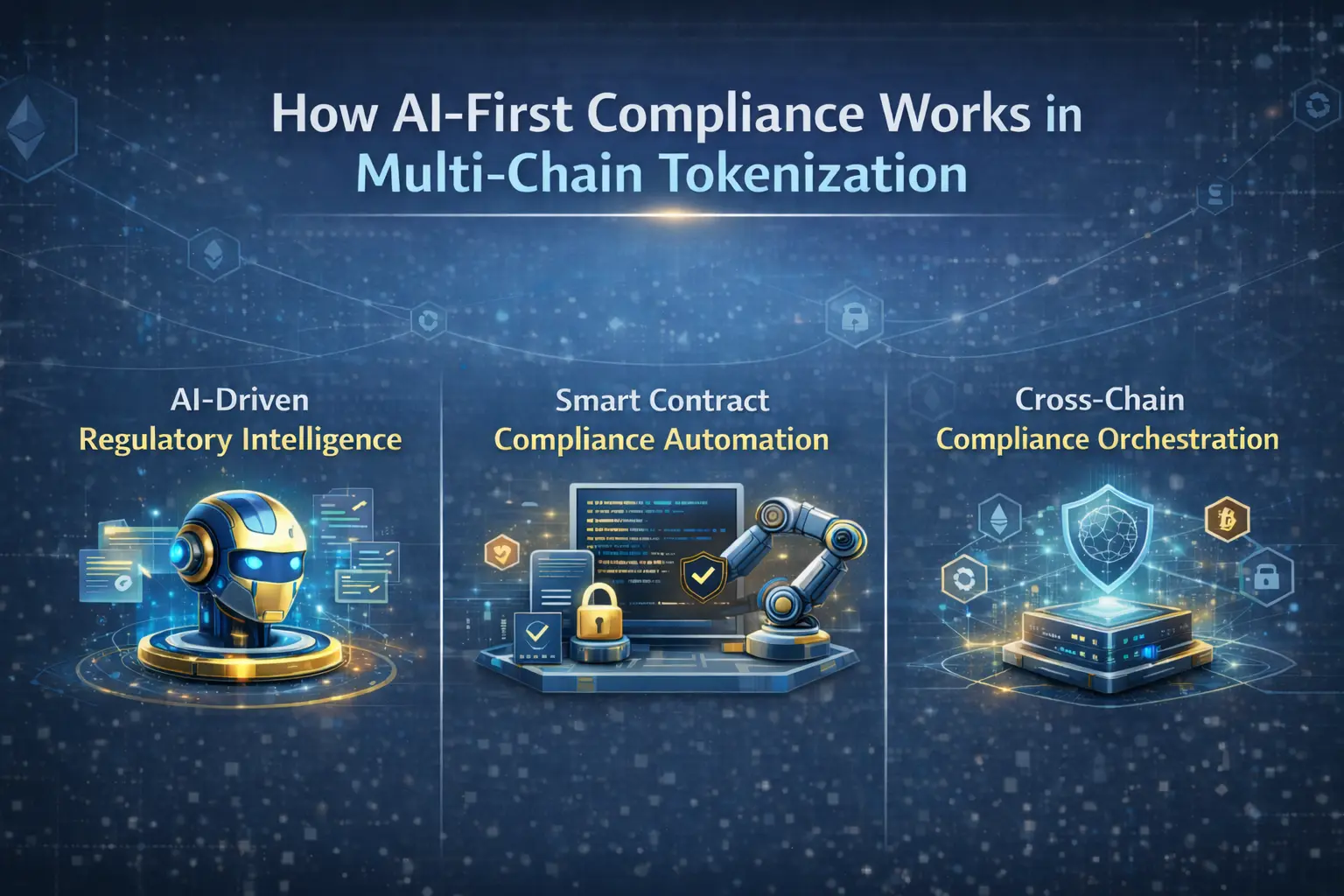
AI-Driven Regulatory Intelligence
AI systems are trained to understand regulatory language and legal structures. Using machine learning and natural language processing, they analyze:
- Global regulatory documents
- Financial compliance standards
- Jurisdiction-specific policies
This enables automated interpretation of laws without relying solely on manual legal reviews.
AI can:
- Identify compliance requirements
- Detect regulatory conflicts
- Update enforcement logic dynamically
Smart Contract Compliance Automation
Smart contracts act as automated compliance enforcers. They ensure that:
- Only verified users can transact
- Assets follow jurisdictional rules
- Illegal transactions are blocked instantly
AI defines the compliance rules, and smart contracts enforce them at the blockchain level.
This creates:
- Zero manual enforcement
- Transparent execution
- Immutable compliance records
Cross-Chain Compliance Orchestration
- Unified compliance across multiple blockchains
Industry Use Cases of AI-First Compliance in Multi-Chain Asset Tokenization
AI-first compliance becomes truly powerful when applied to real-world business ecosystems. Each industry faces different regulatory pressures, asset behaviors, and risk profiles. AI enables compliance frameworks to adapt dynamically while maintaining consistency across multiple blockchains.
FinTech & Digital Securities
In FinTech and digital securities, compliance is mission-critical. Regulations around KYC, AML, investor protection, and securities classification are strict and continuously evolving.
AI-first compliance enables:
- Automated investor verification
- Real-time transaction monitoring
- Jurisdiction-based transaction approvals
- Prevention of unauthorized token trading
For tokenized stocks, bonds, or funds, AI ensures that only legally eligible participants can access and trade assets. This transforms digital securities from experimental products into institution-ready financial instruments.
Real Estate Tokenization
Real estate tokenization involves high-value assets and region-specific property laws. Manual compliance processes become complex and expensive.
AI-first compliance helps by:
- Automating ownership verification
- Managing regional property regulations
- Enforcing investment limits
- Ensuring compliant revenue distribution
As real estate tokens move across chains, AI ensures regulatory consistency without disrupting asset liquidity or ownership rights.
DeFi & Web3 Platforms
DeFi platforms face unique challenges due to decentralized governance and permissionless environments. AI-first compliance bridges decentralization with regulatory accountability.
It enables:
- Risk scoring of wallet activity
- Detection of fraudulent behavior
- Compliance-aligned smart contract execution
- Prevention of illegal financial flows
This allows DeFi platforms to scale while remaining acceptable to institutional and regulatory stakeholders.
NFT Marketplaces & Digital Assets
NFT platforms deal with intellectual property, digital ownership, and cross-border transactions. Compliance requirements include copyright, taxation, and fraud prevention.
AI-first compliance supports:
- NFT authenticity validation
- Copyright monitoring
- Transaction legitimacy checks
- Market manipulation detection
This protects both creators and investors while increasing marketplace trust.
AI-First Compliance Implementation Process
Implementing AI-first compliance requires a structured and enterprise-grade approach. It is not a plug-and-play solution but a systematic integration of AI intelligence with blockchain infrastructure.
Compliance Strategy Design
The process begins by understanding:
- Target industries
- Asset types
- Jurisdictional regulations
- Risk tolerance
A compliance framework is designed that aligns legal requirements with business objectives and platform architecture.
AI Model Training with Regulatory Data
AI models are trained using:
- Legal documents
- Regulatory policies
- Compliance guidelines
- Historical enforcement cases
Natural language processing enables AI to interpret legal language and translate it into actionable compliance rules.
Smart Contract Integration
Compliance rules generated by AI are embedded into smart contracts that:
- Validate transactions
- Enforce user permissions
- Block non-compliant activities
This creates real-time regulatory enforcement at the blockchain level.
Cross-Chain Deployment & Testing
Compliance logic is deployed across:
- Ethereum
- Polygon
- BNB Chain
- Layer-2 networks
Testing ensures:
- Regulatory consistency
- Transaction reliability
- Cross-chain rule synchronization
Continuous Monitoring & Optimization
AI-first compliance evolves continuously by:
- Monitoring regulatory updates
- Updating enforcement rules
- Optimizing risk detection models
- Enhancing performance accuracy
Compliance becomes a living system rather than a static framework.
Technology Stack Behind AI-First Compliance in Multi-Chain Asset Tokenization
AI Stack
- Natural Language Processing (NLP) models
Used to read, understand, and interpret regulatory documents, legal notices, and compliance frameworks.
- Risk scoring engines
Analyze transaction behavior, wallet activity, and user profiles to assess compliance risks in real-time.
- Machine learning models
Continuously improve detection accuracy by learning from transaction patterns and enforcement outcomes.
- Compliance automation systems
Convert regulatory intelligence into executable compliance rules that can be enforced by smart contracts.
Blockchain Stack
- Multi-chain networks
Ethereum, Polygon, BNB Chain, and Layer-2 solutions for scalability and cost efficiency.
- Smart contract frameworks
Used to embed compliance rules directly into token operations, asset transfers, and platform logic.
- Cross-chain bridges and protocols
Enable asset movement while maintaining unified compliance enforcement across networks.
- On-chain logging systems
Create audit-ready transaction histories that satisfy regulatory requirements.
Compliance Infrastructure
- KYC and AML engines
Identity verification, risk classification, and fraud prevention mechanisms.
- Regulatory APIs
Integrations with legal databases and compliance platforms for real-time updates.
- Audit and reporting systems
Generate compliance reports, transaction logs, and regulatory documentation.
- Data security and encryption layers
Protect sensitive legal and user data in compliance with global privacy regulations.
Why Choose Web 3.0 India for AI-First Compliance in Multi-Chain Asset Tokenization?
Building compliant, scalable, and enterprise-grade tokenization platforms requires a partner that understands both blockchain technology and regulatory complexity. Web 3.0 India delivers AI-first compliance solutions that are secure, future-ready, and business-focused.
Web 3.0 India provides complete lifecycle development:
- Compliance strategy design
- AI model development and training
- Smart contract implementation
- Multi-chain deployment
- Continuous compliance optimization
This end-to-end approach ensures consistency, accuracy, and faster go-to-market.