
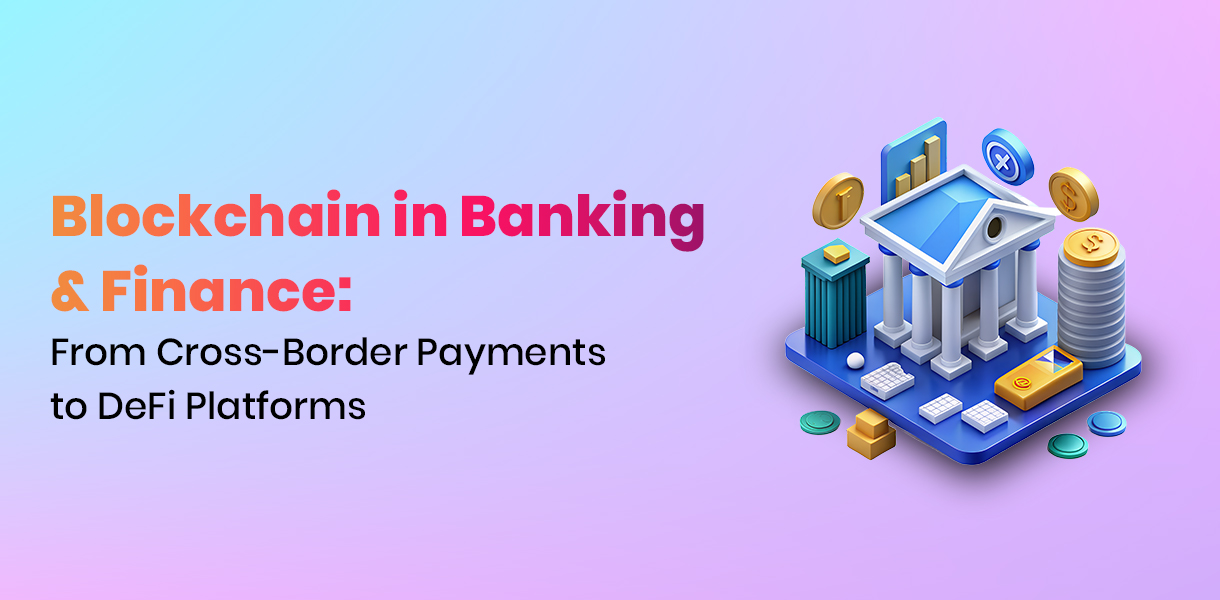
There’s no doubt that the financial industry is undergoing rapid transformation. Right at the core of this change lies the blockchain. Considered the most innovative distributed ledger technology, it fosters decentralization and financial freedom in a true sense. Whether it’s making a cross-border payment or lending on a DeFi platform, it has completely reshaped banking. From delivering optimal efficiency to fostering trustless agreements, a new era of speed and financial inclusion has evolved.
However, not many people are aware of how blockchain in banking & finance works, let alone its advantages. Perhaps that’s why the worldwide acceptance rate is still marginal. Knowledge indeed gives power, and when it comes to a technology like this, we cannot simply rely on news and opinions. That being said, we have crafted a detailed guide here, explaining the contributions blockchain is making toward banking and finance.
Facilitating Cross-Border Payments
Regular cross-border payments involve traditional financial rails. There’s almost minimal to zero transparency. Every transaction requires at least 3 to 5 days for settlement. And let’s not forget how multiple correspondent banks are involved in verification and authentication. In addition, the exchange rates and high fees impose significant burdens on the parties involved.
This is where we consider blockchain in banking & finance. It plays a crucial role in facilitating cross-border payments. Here’s how.
- Several platforms allow almost instantaneous transactions across borders, ensuring real-time settlements without delays.
- No intermediaries will be involved throughout the entire transaction. It automatically cuts down the costs, especially the platform and processing fees.
- Every transaction gets recorded on a private or public ledger. All the involved parties can pull up an audit trail to check the historical details. It further increases transparency and reduces money laundering risks.
- Blockchain-based solutions make banking accessible to remote areas. All users will need is a smartphone and an internet connection.
Digital Identity and KYC Simplification
In the banking sector, AML and KYC compliance have proven to be burdensome and expensive. Lots of effort and time need to be put into verifying these two regulatory standards for users. However, blockchain has revolutionized these segments through the use of digital identities.
- Personal data of every user gets recorded on the private or public ledger. Blockchain makes these immutable, ensuring no more fraud or duplicity of the records.
- Customers get end-to-end freedom in deciding with whom and when to share their credentials. As a result, data privacy is enhanced by leaps and bounds with blockchain in banking & finance.
- Once verification is complete, digital identities can be used across multiple platforms. There’s no need to get them verified separately on individual platforms. This further reduces onboarding times and compliance costs.
Smart Contracts for Automated Financial Agreements
One of the key uses of blockchain in banking & finance is achieved through smart contract deployment. These self-executing programs foster trustless agreements between the involved parties. Unlike regular agreements, where verification is done manually, smart contracts operate through logic embedded in code. Once the premeditated conditions are fulfilled, the actions will be performed without any intervention.
In the finance industry, smart contracts bring the following benefits to the table.
- Funds are automatically disbursed only when the conditions, like credit score checks, are met successfully.
- Insurance claims are settled without any manual intervention only when the events are verified.
- Every transaction is secured without requiring involvement from third-party escrows using smart contracts.
- These facilitate options trading through margin requirements and automated settlements.
To sum up everything, smart contracts cut off administrative overheads by several notches. Transaction processing speeds up, and the manual error margin is reduced through automation.
Decentralized Finance: A Paradigm Shift
The concept of DeFi revolves completely around a blockchain-based financial system. It is primarily built on Ethereum, offering end-to-end access to:
- Users get complete freedom in earning interests or taking out loans by using crypto as collateral.
- Several platforms get integrated with incentivized mechanisms for enhancing liquidity provision and network validation.
- Decentralized Exchanges (DEXs) facilitate peer-to-peer transactions without third-party intermediaries.
- DeFi extends support for blockchain versions of traditional assets, like Stablecoins.
Asset Tokenization and Fractional Ownership
Blockchain allows users to create digital tokens, each representing a unique real-world asset. These can include real estate lands, commodities, stocks, bonds, or artwork. Tokenization brings numerous benefits to the table for the users. Here’s how.
- Fractional ownership: Even a small-scale trader or investor can use tokens to purchase ownership of a real-world asset. It won’t be 100% ownership but rather a fraction. Since every detail is stored on the blockchain ledger, the ownership details become immutable.
- Reduced settlement times: Asset clearance and reconciliation won’t require too long, thanks to the tokenization. This will cut down the settlement times and speed up asset transfers, sells, and purchases.
- Liquidity: Users won’t have to limit themselves with regard to time. In other words, they can trade, sell, or buy assets on global blockchain marketplaces 24/7. To top it off, tokenized pools are accessible for everyone, thereby guaranteeing optimal liquidity.
- Transparency: Every token transfer concerning an asset will be verified on-chain. One can easily pull up the audit trails to check who has been the owner and for how long they held the rights.
Central Bank Digital Currencies: The Institutional Adoption
Both the central banks and government institutions have started exploring blockchain in finance & banking through CBDCs. These are nothing but digital copies of the traditional fiat currencies. Every CBDC is issued by the state authority, ensuring maximum compliance with the regulations. For example, China uses Digital Yuan, whereas India has launched Digital Rupee. With CBDCs, users can enjoy a whole new set of benefits, including:
- Reduced reliance on traditional fiat currencies, especially cash
- Real-time payment processing and faster execution
- Programmable money for specific and targeted fiscal policy
- Improved financial inclusion for non-banking users
CBDCs work on a centralized model. However, they are integrated with numerous blockchain-based features for maximum traceability and improved control. That’s how these are revolutionizing banking operations globally.
Trade Finance and Supply Chain Transparency
Trade finance is always associated with multi-party agreements. These are so complex that there are too many rooms for delays, fraud, and paperwork. However, with blockchain in banking & finance, the process can become more streamlined and efficient. Here’s how.
- Fraud prevention: Once the trade records are stored on the blockchain ledger, they become immutable. From letters of credit to bills of landing, every document will become tamper-proof.
- End-to-end visibility: All the involved parties with access to the network can view the trade finance transactions. To top it off, they can also verify the details on-chain and maintain optimal data integrity.
Challenges and Limitations of Blockchain-Based Banking
Blockchain has indeed paved the way for financial freedom and innovation. However, we cannot overlook the flaws it brings. There are numerous limitations and risks of this paradigm shift. Here’s how.
- Public blockchain networks like Ethereum struggle with scalability. During network congestion, throughput times are quite high, and transaction costs skyrocket.
- Jurisdictions are highly varied in terms of crypto and blockchain regulations. Due to the lack of a standardized protocol, global acceptance is still a far-fetched picture.
- The legacy financial infrastructure still supports the traditional systems and processes. Upgrading it to accommodate blockchain is a costly endeavor.
- Loss of private keys, hacking of blockchain protocols, and smart contract bugs do pose security and privacy risks
- Siloed blockchain networks do not often support interoperability. As a result, users won’t be able to trade tokens or initiate transactions outside the ecosystem as of now.
Conclusion
The future of blockchain in banking & finance lies in combining the best of both worlds. For this, we will still have to wait for clear regulations and infrastructure enhancements. Only then can we rely on a hybrid model that combines both the financial rails seamlessly, blurring the prominent lines of difference. Being a pioneer in blockchain technology, Web 3.0 India brings you the benefits of DeFi, asset tokenization, and smart contract development. Let’s get started on creating a platform that can foster innovation, transparency, and financial inclusion.