
Why Business Models for Tokenization Are Reshaping Digital Economies
Business models for tokenization are transforming how value is created, owned, and exchanged in the digital economy. Instead of relying on traditional centralized systems, tokenization enables businesses to convert real-world and digital assets into blockchain-based tokens that can be traded, shared, or monetized with greater efficiency and transparency.
At a strategic level, tokenization changes the way businesses think about ownership. Assets that were once illiquid or difficult to divide, such as real estate, commodities, intellectual property, or private equity, can now be fractionalized and made accessible to a wider audience. This opens new revenue channels while increasing market participation.
For businesses, tokenization introduces:
- Faster capital generation
- Increased asset liquidity
- Global investor and user access
- Reduced operational friction
Instead of selling a full asset to a single buyer, companies can distribute ownership across thousands of token holders. This allows continuous monetization rather than one-time transactions.
What Is Tokenization?
Tokenization is the process of converting real-world or digital assets into blockchain-based tokens that represent ownership, rights, or access to value.
In simple terms, tokenization takes something valuable, such as property, stocks, artwork, or digital services, and represents it as a digital token on a blockchain. Each token carries verifiable information about ownership, transferability, and usage rights.
These tokens can represent:
- Physical assets (real estate, gold, equipment)
- Financial assets (equity, bonds, funds)
- Digital assets (NFTs, in-game items, licenses)
- Utility access (platform services, memberships)
Tokenization works by combining blockchain infrastructure with smart contracts. Smart contracts define how tokens behave, including:
- How they are created
- How are they transferred
- How revenue is distributed
- How compliance rules are enforced
From a business perspective, tokenization creates a new foundation for business models for tokenization by enabling:
- Asset fractionalization
- Instant settlements
- Transparent ownership records
- Automated revenue distribution
This makes business operations more efficient while unlocking new monetization strategies that were not possible with traditional systems.
Core Revenue Streams Explained
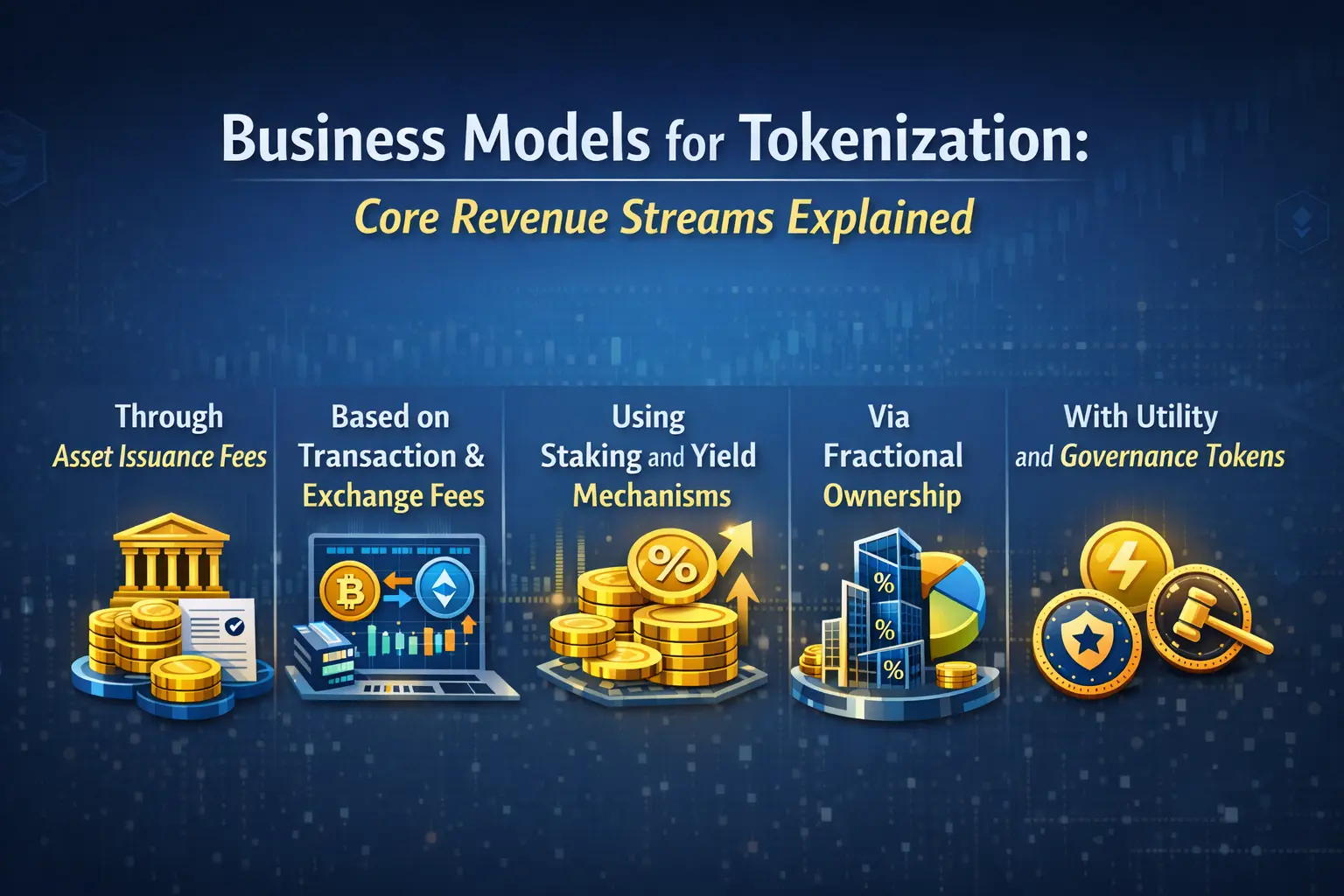
These models go beyond simple token issuance and focus on long-term monetization, scalability, and user participation. Each model serves a different business objective depending on the nature of the asset, platform design, and target audience.
Through Asset Issuance Fees
One of the most direct revenue models is charging fees for token creation and issuance. Businesses that offer tokenization platforms or asset digitization services earn by helping clients convert real-world or digital assets into blockchain-based tokens.
This includes:
- Token design and configuration
- Smart contract deployment
- Compliance framework setup
- Blockchain integration
Companies generate revenue by charging:
- One-time setup fees
- Token issuance fees
- Platform onboarding charges
This model is widely used in asset tokenization platforms, NFT marketplaces, and enterprise blockchain solutions.
Based on Transaction & Exchange Fees
This is one of the most scalable business models for tokenization. Businesses earn revenue by charging a small fee for every transaction that occurs within their ecosystem.
Common fee types include:
- Token transfers
- Marketplace trades
- Asset sales
- Exchange conversions
As transaction volume increases, revenue grows organically. This model is commonly used by:
- Crypto exchanges
- NFT marketplaces
- DeFi platforms
- Tokenized asset trading platforms
It creates a long-term revenue stream directly tied to user engagement.
Using Staking and Yield Mechanisms
Staking models allow token holders to lock their tokens in a platform to earn rewards. Businesses monetize this by:
- Charging platform participation fees
- Using staked tokens for liquidity
- Offering premium yield services
This model strengthens ecosystem stability and encourages long-term user retention.
Staking is commonly used in:
- DeFi protocols
- Blockchain networks
- Tokenized financial platforms
Via Fractional Ownership
Fractional ownership enables businesses to divide high-value assets into smaller token units. This allows multiple investors to own portions of the same asset.
This model generates revenue through:
- Asset tokenization services
- Trading fees
- Revenue-sharing mechanisms
- Management commissions
It is widely applied in:
- Real estate tokenization
- Art and collectibles
- Investment funds
- Infrastructure projects
Fractional ownership increases liquidity and market participation.
With Utility and Governance Tokens
Utility and governance tokens give users access to platform features or decision-making power.
Businesses monetize by:
- Selling premium access via utility tokens
- Charging fees for governance participation
- Creating exclusive platform privileges
This model is ideal for:
- DAO ecosystems
- Gaming platforms
- Web3 communities
It transforms tokens into digital membership and governance tools.
Technical Foundation Behind Business Models for Tokenization
Blockchain Infrastructure & Smart Contracts
Blockchain acts as the decentralized ledger that records token ownership and transactions. Smart contracts automate:
- Token issuance
- Ownership transfers
- Revenue distribution
- Compliance enforcement
This removes intermediaries and ensures operational efficiency.
Blockchain infrastructure enables:
- Trustless transactions
- Immutable records
- Global accessibility
Compliance Layer Supporting Business Models for Tokenization
Regulatory compliance is critical in token-based business models. A compliance layer ensures:
- KYC/AML implementation
- Jurisdictional regulations
- Investor protection rules
- Audit-ready transaction logs
Compliance transforms tokenization from experimental technology into enterprise-ready infrastructure.
Token Standards Powering Business Models for Tokenization
Token standards define how tokens behave on a blockchain. Common standards include:
- ERC-20: Fungible tokens (currency, utility tokens)
- ERC-721: Non-fungible tokens (NFTs)
- ERC-1155: Hybrid tokens (gaming and multi-asset platforms)
Token standards ensure:
- Interoperability
- Security
- Ecosystem compatibility
They form the technical rules that make business models for tokenization scalable and reliable.
Why Choose Web 3.0 India for Business Models for Tokenization?
Choosing the right technology partner is critical for building sustainable and compliant business models for tokenization. At Web 3.0 India, we combine deep Web3 expertise with enterprise-grade development practices to help businesses design token economies that are secure, scalable, and revenue-driven.
We do not approach tokenization as a one-time development task. We treat it as a long-term business architecture that must support growth, compliance, and evolving market dynamics.
End-to-End Tokenization Development
We offer complete tokenization services under one roof, including:
- Token economy design and business model consulting
- Smart contract development and auditing
- Asset tokenization platforms
- Token marketplaces and exchanges
- Wallet and DeFi integration
- Post-launch optimization and scaling
This end-to-end approach ensures consistency, security, and faster go-to-market.
Start Building Your Business Models for Tokenization
The future of digital economies belongs to businesses that can tokenize value, automate trust, and create programmable revenue streams. Whether you want to tokenize assets, build a token marketplace, or launch a Web3 platform, the foundation lies in strong business models for tokenization.
With Web 3.0 India, you gain:
- Strategic tokenization consulting
- Secure and compliant development
- Enterprise-grade architecture
- Scalable Web3 ecosystems
We help you move from concept to production with clarity, speed, and confidence.