
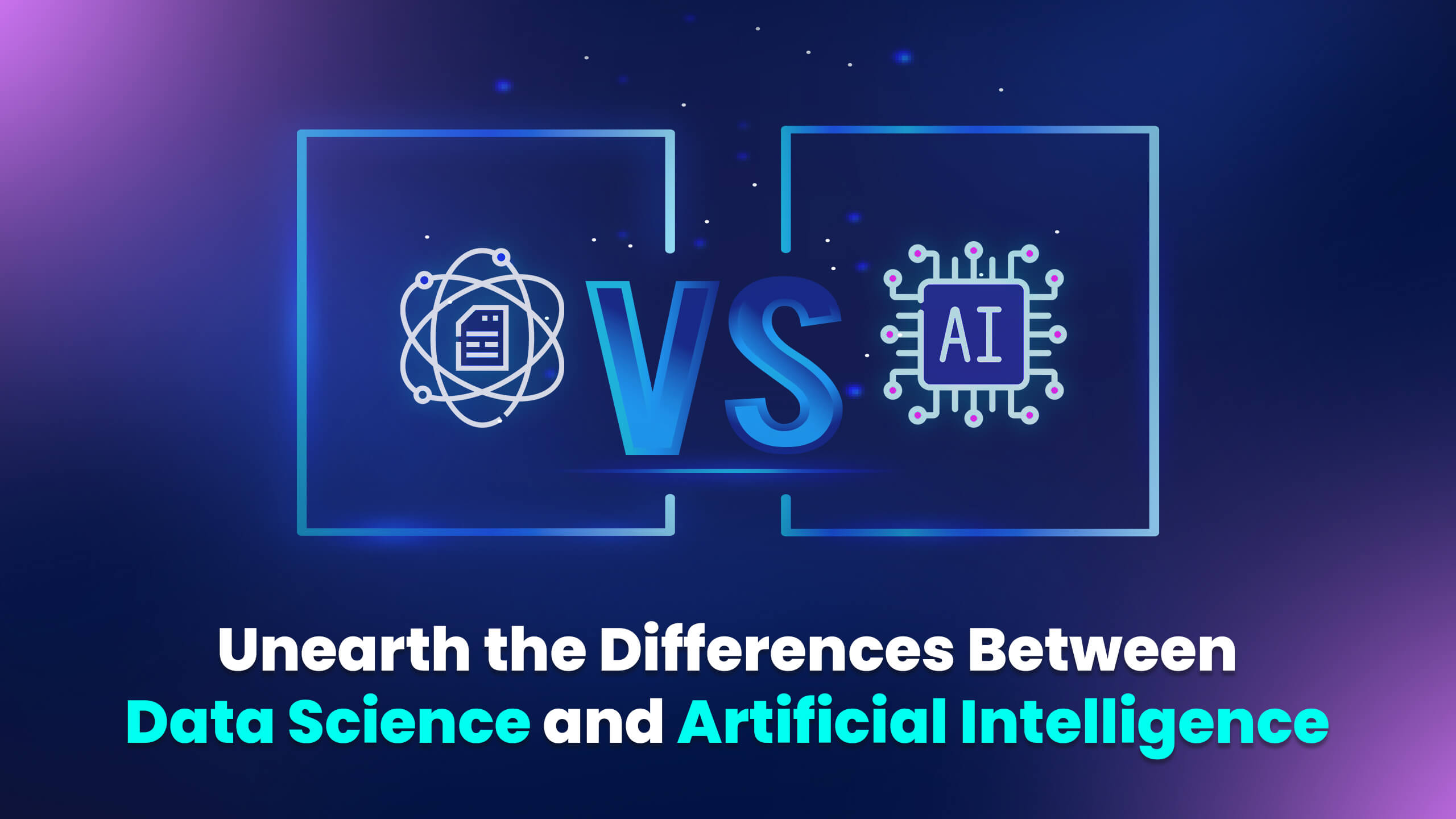
Gone are the days when extracting numbers and unearthing information from them were considered impossible and cumbersome. In today’s digital ecosystem, data has become the superior weapon, providing intel like none. Whether you want to know customer preferences from their search history or gain insights into the performance of your marketing funnel, studying the relevant data will help you gather valuable information with authenticity and reliability. Now, studying data is not a walk in the park because most often, businesses and organizations have to deal with humongous volumes having both structured and unstructured datasets. Besides, a simple look will make you realize that datasets when left unattended are simply random numbers that won’t make sense. This is where data science and artificial intelligence enter the stage! Considering the two faces of the same coin, both technological approaches will help you extract accurate and important information from data and evaluate the same for advanced cognitive and decision-making abilities. However, you cannot superimpose these terms on one another because they have significant differences between their approaches, applications, and other aspects. So, to utilize data science and artificial intelligence to enhance your analytical capabilities and pave the way for innovation and digital transformation, it’s mandatory you acknowledge their differences.
What Is Data Science?
As the name implies, data science acts as a convergence platform for diverse techniques, complex algorithms, and deep domain knowledge to collect, sort, and evaluate structured and unstructured datasets. It focuses on the scientific study of data through statistics, mathematics, and advanced computational practices, allowing professionals to unearth hidden trends and patterns in random numbers. Data science is not just a technology but rather a practice that brings together multiple technical approaches under the same umbrella. For instance, it requires different programming languages, including Python, R programming, and SQL for data manipulation along with diverse techniques including data cleansing, visualization, model validation, and feature engineering.
What Is Artificial Intelligence?
Now, next comes artificial intelligence, an advanced and modern-world approach to creating machine models that can imitate human intelligence and go beyond our restricted vision and capabilities. For example, training a software model to study user behavior and provide necessary guidance through chat programs can be considered as a basic implementation of artificial intelligence. The systems are configured in a way that they can perform several human functions, like decision-making, problem-solving, natural language processing, training, and many more. The foundation of every artificial intelligence system is the neural network, a machine learning algorithm that mimics the human brain’s structure and capabilities for computational systems.
Advantages of Data Science And Artificial Intelligence
Data Science Benefits
- It facilitates better decision-making strategies by providing valuable insights into several arenas through data.
- Data science can help enhance process efficiency by correctly detecting loopholes and allowing professionals to implement optimized strategies.
- Businesses can leverage data science results to improve customer experience by catering to their requirements and optimizing the products or services.
- Data science acts as the best approach for predicting customer preferences and actions based on historical records and market trends.
- Handling finances, accurately forecasting sales, and curating variable pricing models are possible with advanced data science and analytical models.
Artificial Intelligence Benefits
- Artificial intelligence when combined with natural language processing can help systems to unearth information from audio, voices, speech, and other forms of input data.
- It acts as one of the best techniques to facilitate process automation by integrating training layers in the model according to a specific set of instructions.
- AI when introduced to a system reduces the risks of human errors, thereby enhancing system efficiency and improving the business deliverables.
- Artificial intelligence amalgamated with machine learning algorithms can allow businesses to show excellent analytical capabilities and utilize data in the best possible manner.
- Also, artificial intelligence can help businesses offer omnichannel and personalized products or services to their customers, thereby fostering enhanced user experience.
Challenges With Data Science And Artificial Intelligence
Data Science Challenges
- Acquiring data from multiple sources and categorizing them based on certain variables is a huge challenge for data scientists and analytics.
- Not all data science models are trained to deal with any new form of dataset automatically. Manual intervention is required to modify the training layers.
- Data science models are hard to scale, meaning they won’t deliver the exact results once the input form is changed or a larger data volume is fed to the model.
- The functionality of the data science models depends on data availability. So, if enough information is not available, accurate results won’t be generated.
- Data security is also a challenge since confidential information needs to be evaluated often and proper implementation of the security protocols can prove to be difficult.
Artificial Intelligence Challenges
- One of the major challenges in artificial intelligence is upholding ethics, like defining the appropriate way of using confidential information or preventing privacy violations.
- Creating an unbiased AI model is a serious challenge for professionals where the results provided won’t be criticized or judgmental.
- Integrating artificial intelligence into existing systems and processes is also a huge challenge since it might require re-configuration from scratch or major changes to the underlying technical architecture.
- High-performing systems like GPUs and TPUs will be required to cater to the advanced computational needs of AI models.
- Also, maintaining data privacy and security has posed a challenge for AI development companies since the models are often exposed to external vulnerabilities and threats.
Similarities Between Data Science And Artificial Intelligence
1. Predictive Ability
Prediction and forecasting are the primary responsibilities of both data science and artificial intelligence approaches. Professionals leverage the models to read and evaluate historical records from multifarious sources and generate accurate predictions about different variables, including sales figures, market trends, price action movements, and customer choices.
2. Data Quality Needs
For data science and artificial intelligence to perform optimally and meet the requirements, the models require clean and processed datasets as the input. If the numbers do not make enough sense or are in the raw form, the models won’t be able to evaluate them and generate the expected results. Hence, professionals implement different techniques, like data cleansing, data processing, data sorting and filtration, and many more to ensure the models can perform as per the training layers.
3. Technological Convergence
AI and data science professionals leverage similar technical approaches to train the models, evaluate the input datasets, and maintain accuracy and precision in the results. For example, both models can use machine learning algorithms so that the data evaluation reports can be accurate, efficient, and value-effective.
4. Unified Goals
Another key similarity between the approaches can be based on their goals. Both techniques are used to improve the analytical and decision-making skills of the professionals. Additionally, they can be leveraged to generate forecasts for future decisions, process automation, and efficiency enhancement of the organization or business.
Key Differences Between Data Science And Artificial Intelligence
Despite having similarities, data science and artificial intelligence do have significant differences that should be taken into account for accurate and appropriate implementation. Only then the results will make sense and yield the expected results. So, in this below section, we have explained the areas where AI and data science begin to diverge.
1. Scope
Data science is concerned with analyzing huge volumes of data and generating reports about the trends, providing valuable information regarding any process, and identifying patterns. As a result, the results can be leveraged for better decision-making and fostering agility and innovation across various processes. On the other hand, artificial intelligence focuses on a broader approach by allowing to creation of intelligent and smart systems that mimic human intelligence. From accurately perceiving the environment to analyzing user sentiments or intent of actions, AI is focused on providing insights into behavior, surroundings, and other elements that can’t be accessed merely through data.
2. Methodologies
The four major methodologies involved with data science are data visualization, machine learning, statistical computation, and data mining for processing and analyzing the input data and generating accurate results. Contrary to this, AI depends on more advanced and state-of-the-art techniques, like machine learning algorithms, natural language processing, business intelligence, big data, robotics, and computerized vision to mimic human intelligence and evaluate behaviors and sentiments.
3. Applications
While the application areas of both data science and artificial intelligence are quite similar, their use cases create the bifurcation. For example, data science is used in the healthcare industry for research work, evaluation of patient conditions, predicting the success rate of a new drug, and many more. On the other hand, AI enables surgeons to perform complicated procedures with robotics, track the movements of medical supplies through integrated IoT devices and sensors, and make appropriate decisions about healthcare processes. So, the technologies might target the same industry but their real-time implementation is quite different.
Conclusion
In this article, we have explained the differences and similarities between the top two technical approaches in today’s digital realm, namely data science and artificial intelligence. So, based on this illustration, it’s time you make the call on whether diverged approaches will help your business overcome the challenges or whether you want to implement a converged system that utilizes the plus points of both data science and AI.