
In recent years, personalized care within the comfort of one’s home has attracted the limelight. People look for professionals who can help ease their daily lives and provide unwavering mental and moral support. Whether it’s for elderly people or someone who recently underwent surgery, this is the most feasible approach. However, the conventional practices have created a lot of communication and data silos. It prevents the home care professionals and their clients from staying on the same page. To top it off, this also causes friction and reduces the service quality.
This is where digital transformation comes into the picture! It has become a necessity in today’s time, paving the way for fostering innovation and agility in the home care industry. From reducing paperwork to facilitating real-time communication, it brings numerous benefits to the table. Having said that, we will further explore how digital evolution can raise the standards for home care.
The Need for Digital Transformation in Home Care
Challenges in Traditional Home Care Operations
Manual Scheduling
Conventional systems have a huge reliance on spreadsheets and phone calls for appointment scheduling. As a result, businesses struggle with innumerable issues, including:
- Increased error margin
- Overlapping shifts
- Underutilized and overutilized resources
Hence, caregivers find it difficult to attend to client needs promptly.
Paperwork Overload
Paper-based documentation is indeed cumbersome! Excessive manual work slows down the overall work speed. Efficiency gets decreased significantly. What’s more, the administrative department has to work overtime, causing employee fatigue. Potential risks of lost and incompetent records also get multiplied significantly. All in all, these can impact the regulatory compliance negatively.
Communication Gap
Another challenge that traditional home care operations have is a sheer gap in communication. Lack of real-time updates prevents clients, administrators, and caregivers from working cohesively. In addition, disconnected systems introduce significant delays in home care services.
Evolving Client Expectations
Most customers demand real-time updates and complete visibility into the home care services. Faster response time is always preferred over everything else. In addition, people look for digital portals for the ease of appointment scheduling. So, digital transformation is required for home care businesses to cater to these growing expectations.
Industry Push Towards Compliance and Efficiency
In recent years, home care companies have faced penalties and legal liabilities. That’s because of the sheer absence of transparency in regulatory compliance. This is where digital transformation comes into play! Accurate documentation, timely license renewal, and streamlined operations are a few benefits to name.
Digital Appointment Scheduling
Booking slots and assigning caregivers manually are never feasible. Given how fast-paced the industry has become, businesses need something innovative. This is where digital appointment scheduling enters the picture! It focuses on the use of a digital tool to reduce errors and implement automation. No more phone calls or spreadsheet usage.
Here are a few benefits this can offer.
- The schedules of every caregiver can be updated in real-time. As a result, clients will gain greater visibility into the available slots. This will further help in reducing the risks of overlapping shifts and fatigue.
- No-shows and miscommunication can be eliminated. A digital appointment scheduling tool can send notifications and real-time reminders to the caregivers. Hence, they will stay on track and communicate with the clients further.
- The portal can be integrated with the staff calendars seamlessly. It will help visualize the shifts of all caregivers from a centralized dashboard.
Mobile and Web-based Portals
Home care businesses can capitalize on a centralized platform to streamline communication. Merging the caregiver and client portals will bring numerous benefits to the table. Here’s how!
- Access to schedules: Third-party dependency will be eliminated. Clients and caregivers can access each other’s schedules seamlessly. Viewing and managing appointments will become easier. As a result, scheduling conflicts can be reduced easily.
- Real-time updates: Any change in the appointment will trigger an automatic notification. This will help both parties to stay updated without any communication gap.
- Direct connection: An integrated messaging app will help streamline the communication between the parties. This will ensure maximum availability and prompt responses.
Remote Documentation and Care Notes
Timely documentation will bring a lot of benefits for home care businesses. These include:
- Precise electronic health records will allow caregivers to identify allergies and other severe conditions for their clients. Potential complications can be further eliminated from the picture.
- All healthcare providers will have access to consistent care records. This will further facilitate a coordinated and holistic treatment approach.
- Well-maintained data will help avoid legal penalties. Disputes can be resolved, and healthcare providers can prevent malpractices.
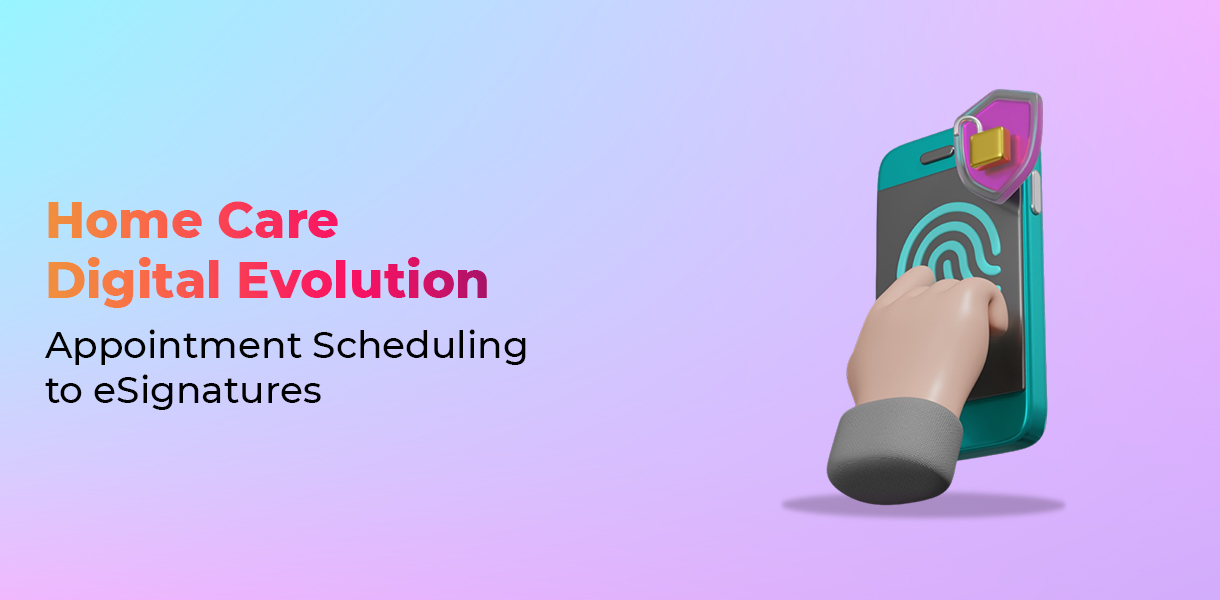
Businesses can implement mobile apps to foster digital transformation. These will help in instant note submission without delays. The voice-to-text feature will save a lot of time through hands-free note recording. In addition, offline capabilities will help remote access to the note care.
eSignatures and Paperless Agreements
Implementing the practice of eSignatures will allow seamless document handling. The U.S. Electronic Signatures in Global and National Commerce Act recognizes these signs as valid proof. Whether it’s a service agreement or a visit verification, all documents will be HIPAA-compliant. Below are some of the benefits you should know.
- Digital forms minimize the error margin significantly.
- Clients and caregivers can acknowledge documents remotely.
- It enhances accessibility and convenience.
Integration and Interoperability
The need for an integrated system has gained immense traction in the home care industry. It facilitates seamless data flow between different teams working together. Billing, HR, scheduling, and other modules can access centralized data for better efficiency. Manual entries will no longer be needed. Some of the best platforms businesses can leverage are:
- ClearCare
- AlayaCare
Wrapping up
Manual operations introduce significant error margins in home care operations. Clients and caregivers face numerous hurdles in communication. To top it off, it further causes friction and impacts work efficiency. So, look no further and collaborate with Web 3.0 India. Our technical prowess and domain knowledge will help pave the road for digital transformation. We will build a custom mobile or web-based portal to bridge the communication gap for your business.