
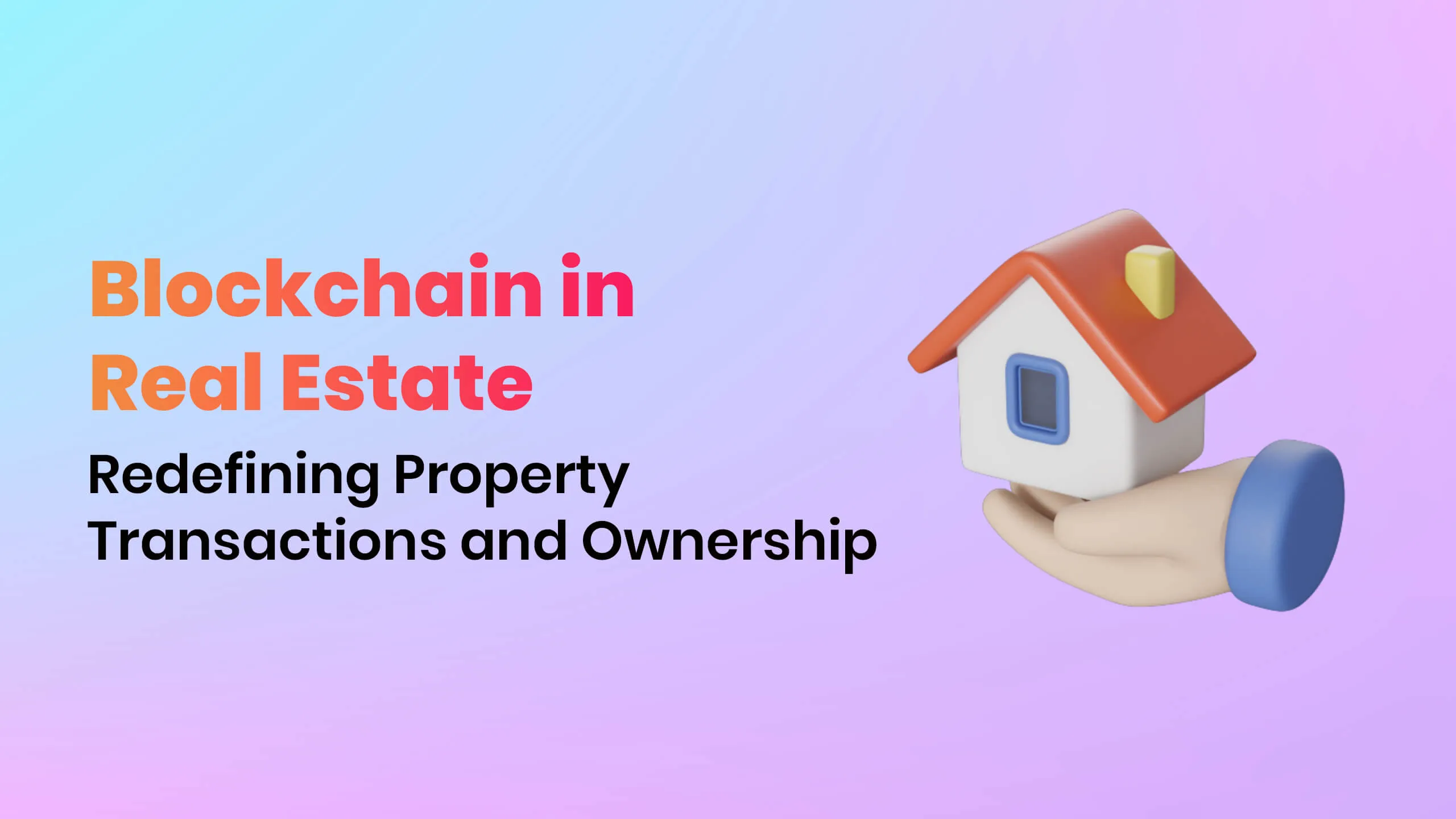
What is blockchain in real estate? Blockchain in real estate refers to using decentralized ledger technology to record, verify, and manage property transactions securely and transparently.
Whether it’s in the investment world or the finance ecosystem, real estate has always been a heavyweight. From the tools to the players, innumerable chess pieces coexist. Imagine buying a property in Singapore from India. Right from day one, you will be overwhelmed with the heaps of paperwork to be dealt with. Then come the intermediaries, brokers, and local regulations. Combinedly, all these will only result in unnecessary delays.
But what if we say now you have an ecosystem where real estate gets digitized? Blockchain integration not only addresses these concerns right at the core but also fosters a transformative journey. Ownership, transactions, access, and transparency, everything gets redefined with this DLT. That being said, let’s unravel how blockchain in real estate can be the real game changer in today’s digital realm.
What Does Blockchain Bring to the Real Estate Industry?
On-Chain Property/Land Registries

From missing records to forged documents, the list of concerns with paper-based registries is endless. This often leads to ownership disputes and fraudulent title transfers. However, with blockchain in real estate, the problem can be addressed right at its core.
How It Helps:
- Immutable digital records are immune to manipulation or alteration.
- Ownership history and liens can be verified easily on the chain.
- The property transfer process speeds up significantly.
- Due diligence becomes more streamlined and simplified.
- Traceable, transparent data helps build consumer trust.
Smart Contracts for Sale & Lease Processes

Traditional property deals mean longer waiting periods, loads of paperwork, and too many human errors. This is where smart contracts enter the picture. These foster fairness and automation, ensuring users won’t have to get overwhelmed for any property deal.
Why Is It a Game-Changer?
- Once conditions are met, leases and sales get executed automatically.
- Dependencies on intermediaries like brokers can be eliminated.
- Pre-coded transparency minimizes the risk of ownership disputes.
- Title transfers and payments get accelerated through process automation.
Tokenization & Fractional Ownership

Every real estate investment involves massive capital requirements. Hence, small investors often encounter high entry barriers. In other words, the industry is limited to the wealthy section only. However, the integration of blockchain in real estate flips the entire picture.
Why Is It Transformative?
- Real estate properties can be divided into smaller units, each being represented by a token. This enables fractional ownership.
- Small investors won’t have to invest large amounts of capital up front to gain ownership rights.
- Token trading on decentralized marketplaces fosters high liquidity in the real estate market.
- Local assets become accessible globally, without having border restrictions.
Cross-Border Transactions/Global Investments

Buying or selling property across international borders comes with numerous challenges. Most transactions involve excessively high fees. To top it off, legal regulations also pose a challenge to the success of the deal. This is where blockchain in real estate makes a real difference.
Key Global Advantage
- It reduces the friction between banking and foreign exchange.
- Investors can purchase properties seamlessly across borders using Decentralized Identifiers.
- Ownership gets verified on-chain to foster trust and end-to-end transparency.
- Cross-border fraud risks can be mitigated with ease.
- Meeting compliance regulations in the real estate industry becomes streamlined.
Project Financing, Crowdfunding, & REITs

It’s no secret that investors face a lack of transparency across the real estate market. Developers also struggle with raising the funds required for property projects. Blockchain, however, bridges the gap between both sides efficiently.
How Does It Fuel the Ecosystem?
- It enables token-based crowdfunding for different real estate projects.
- Profit distributions and investor contributions can be easily tracked in real time.
- Verified financial flows ensure minimal disputes and maximum trust.
- On-chain dividends simplify the REIT structures.
Improved Identity/KYC/AML Verification

Manual identity verification is slow and costly. It often adds unexpected delays in a real estate deal. Besides, too much paperwork means more room for identity manipulation. On the contrary, blockchain in real estate addresses this concern easily by building a secure backbone.
Core Benefits
- Verifiable digital identities can be stored on-chain for faster KYC processing.
- Property transactions get linked to authorized users only.
- Auditable trails simplify the AML compliance process.
- Impersonation and forgery risks can be reduced by several notches.
Property Management & Maintenance

Post-sale management is indeed chaotic. From delayed repairs to missed rents and manual record-keeping, investors often feel overwhelmed. This is where blockchain plays the most crucial role via smart automation.
Operational Boosts Include:
- Smart contracts can auto-trigger contract renewals and rent payouts.
- Tenant-landlord communication gets simplified, with more emphasis given to accountability.
- IoT integration will enable monitoring through real-time maintenance logs.
- Repair requests and additional expenses can be seamlessly tracked on the chain.
Transparency, Auditing, and Reduced Intermediary Costs

Too many middlemen and opaque data lead to eroded confidence and market inflation. That’s why integrating blockchain in real estate is more necessary now than ever.
Trust-Building Strengths
- Legal verification fees and unnecessary brokerage charges won’t be involved any longer.
- Immutable audit trails ensure accountability and trust amongst all parties.
- Data duplication and manipulation can be prevented easily.
What’s Already Happening: Emerging Trends & Real Examples
Blockchain integration with the real estate market is no longer a futuristic vision. Instead, it has already been in practice. Hence, to help you understand better, we have listed a few real-world examples and pilot projects below.
- A few land title registries have been deployed to the blockchain network for tracking ownership and liens.
- Numerous investment companies and platforms offer tokens representing real-world assets for fractional ownership.
- Several infrastructures leverage a hybrid model—blockchain for immutability and off-chain components for identity checks and legal filings.
- IoT-based data gets stored on the blockchain ledger for smarter property management and maintenance.
What’s Slowing Blockchain Down: Real Obstacles to Address
Regulatory and Legal Uncertainty
Laws are never the same in two different countries. Smart contracts, digital ownership, and tokenization are yet to be legally recognized. As there’s no clarity, several real estate firms become hesitant to invest in blockchain.
Performance and Scalability
Using public networks, like Ethereum, won’t be feasible in the long run. These primary chains often suffer from high network congestion. Hence, real estate transactions will slow down, and investors will be charged with high gas fees.
Resistance to Change and Lack of Trust
From title companies to civil lawyers and local government offices, these key players still rely on legacy frameworks. As they are more acquainted with the traditional work processes, adapting to such a massive transformation won’t be easy.
Balancing Transparency Vs Data Privacy
On the one hand, blockchain in real estate demands end-to-end transparency. On the other hand, data stored on the ledger can be viewed by any network user. This has raised concerns about data privacy and security.
Conclusion
Blockchain’s promise is completely real in real estate. However, it’s not a magic bullet that can be adopted overnight. Full-scale adoption is still considered a far-fetched idea due to numerous roadblocks. Only by addressing these challenges can blockchain truly reform how we perceive real estate in today’s time. So, if you are a property investor or a tech entrepreneur, reach out to our experts at Web 3.0 India to learn about the future of blockchain in real estate.