
The decentralized ecosystem has surged in recent years. More businesses have integrated revolutionary blockchain technology with their core technical infrastructure. After all, blockchains like Ethereum offer a host of benefits to the users. From making transactions immutable to increasing transparency, the list goes on. According to Gartner Research, the overall revenue of the blockchain market is expected to touch a whopping $3.1 trillion by 2030. This number proves the growing dominance of this DLT in the DeFi ecosystem. Ethereum’s ecosystem has expanded significantly. DeFi protocols, dApps, and NFTs are some of the major contributors to this expansion. However, the ability of the blockchain’s underlying infrastructure to accommodate all these changes is concerning. Several scalability issues have come into the limelight. For instance, network congestion and high transaction fees during peak times have questioned Ethereum’s performance. That’s why Ethereum Layer 2 solutions are required to tackle these bottlenecks.
What are Layer 2 solutions?
The main blockchain network is responsible for all operations. These include providing consensus, validating transactions, executions, and many more. In the beginning, the tasks can be performed without any issues. However, with increasing transaction volume comes lots of challenges. The major problem arises with scalability. Most often, the parent networks fail to support the incoming transaction volume. It results in increased execution time and extremely high transaction fees. That’s where Layer 2 solutions come into the picture! You can consider it to be a secondary network. A Layer 2 network is a child blockchain ecosystem that takes off the load from the primary network. It is capable of performing only a few functions. However, the major control still rests with the Layer 1 blockchain. In other words, the parent network remains responsible for validation and providing consensus. On the other hand, the Layer 2 network handles the transaction execution part.
Layer 1 blockchain | Layer 2 blockchain |
| It is the parent blockchain network. Network security and transaction validation are the main functions. | This is the child or secondary blockchain network. It is responsible for transaction execution mainly. |
| Its design puts limitations on scalability. | Layer 2 blockchain offloads transactions from the parent network. |
| Transaction execution speed is typically slower. That’s due to network congestion and limited scalability. | Transaction execution speed is quite high. That’s because the Layer 2 blockchain is designed only for the concerned purpose. |
| Transaction fees surge during peak times and network congestion. | The fees remain considerably low due to higher network scalability. |
| It comes with an independent consensus and security model. | The Layer 2 blockchain depends on the parent network for consensus and validation. |
Ethereum’s scalability challenges
Ethereum has always encountered the famous blockchain trilemma. It states that every blockchain network needs to make two choices among three options. These are decentralization, security, and scalability. Ethereum has prioritized the former two. It is known for the decentralization capabilities that most other blockchains fail to offer. Also, the security and data privacy protocols are quite advanced. That’s why users can rest assured that their transactions will remain secured to the very end. Owing to this, Ethereum’s scalability was never in the picture. As the ecosystem expanded, issues started coming up. The underlying architecture of the primary network failed to accommodate the growing activities. It resulted in numerous challenges, like:
- The transaction processing ability is only within 15 to 30 TPS. It’s significantly lower than what should be.
- Only 1700 transactions can be executed every second. This proves to be one of the major challenges, especially during peak times.
- Adding and making the transaction irreversible takes 15 minutes on Ethereum. It slows down the overall operation significantly.
- Network congestion is a common occurrence. When high transaction volumes need to be handled, Ethereum’s speed takes a dip.
- The abrupt surge in gas fees is another problem caused by to lack of scalability.
Key Layer 2 Solutions: Polygon and Arbitrum
Truth be told, Ethereum’s scalability has become the primary concern for both developers and users. The challenges put a constraint on its true potential. As a result, using the Layer 1 network is difficult, especially during peak times. To address these, Layer 2 solutions have been adopted. While there are many approaches, Polygon and Arbitrum have become the most feasible solutions. Below we have discussed how these take the load off from Ethereum’s primary Layer 1 network.
Overview of Polygon
Polygon is a sidechain of the Ethereum network. It acts as a secondary ecosystem that takes the load off for scalability. Currently, several Polygon protocols are already active on the Ethereum blockchain. These are:
Polygon PoS
It is the original Polygon chain established in 2020. The network is capable of handling high transaction volumes during peak times. Even then, the transaction fees remain within $0.015. Its design is similar to that of a plasma chain. In other words, it has 100 validators who need to reach a consensus for block commitments on Ethereum’s Layer 1 network.
Polygon CDK
This Chain Development Kit has been of great use to the developers. It allows them to build scalable and customizable Layer 2 solutions. The chains can be connected to both Ethereum and Polygon ecosystems without any hassle. It also leverages the zero-knowledge proofs consensus mechanism. Hence, transaction execution speed is quite high along with higher security and interoperability.
Polygon zkEVM
This Layer 2 solution uses Zero-Knowledge Proofs for consensus. As a result, transaction execution speed gets enhanced by several notches. Also, the surges in gas fees can be limited during peak activities. It supports smart contracts and other tools related to Ethereum. Hence, developers can seamlessly deploy dApps and other operations to this secondary layer.
Overview of Arbitrum
Arbitrum is one of the best Layer 2 solutions for Ethereum. It increases the primary layer’s capabilities by scaling the network. Unlike Polygon which functions as a sidechain, Arbitrum uses optimistic rollups. Here, all the transactions are bundled up and then processed on the Arbitrum’s ecosystem. During the rollup, it’s assumed that all transactions are valid. Further verification is carried out on Ethereum’s network in case of disputes. If the transaction is invalid, the user is penalized financially. That’s how Ethereum can handle higher transaction volumes without network congestion. Another important aspect of Arbitrum is the Virtual Machine. It allows smart contract execution seamlessly by maintaining complete compatibility with EVM. Developers can capitalize on AVM’s low latency and high throughputs to deploy dApps and smart contracts.
Benefits of Layer 2 solutions
Investing in Ethereum Layer 2 solutions comes with a host of benefits. In the below section, we have provided brief insights about the same. 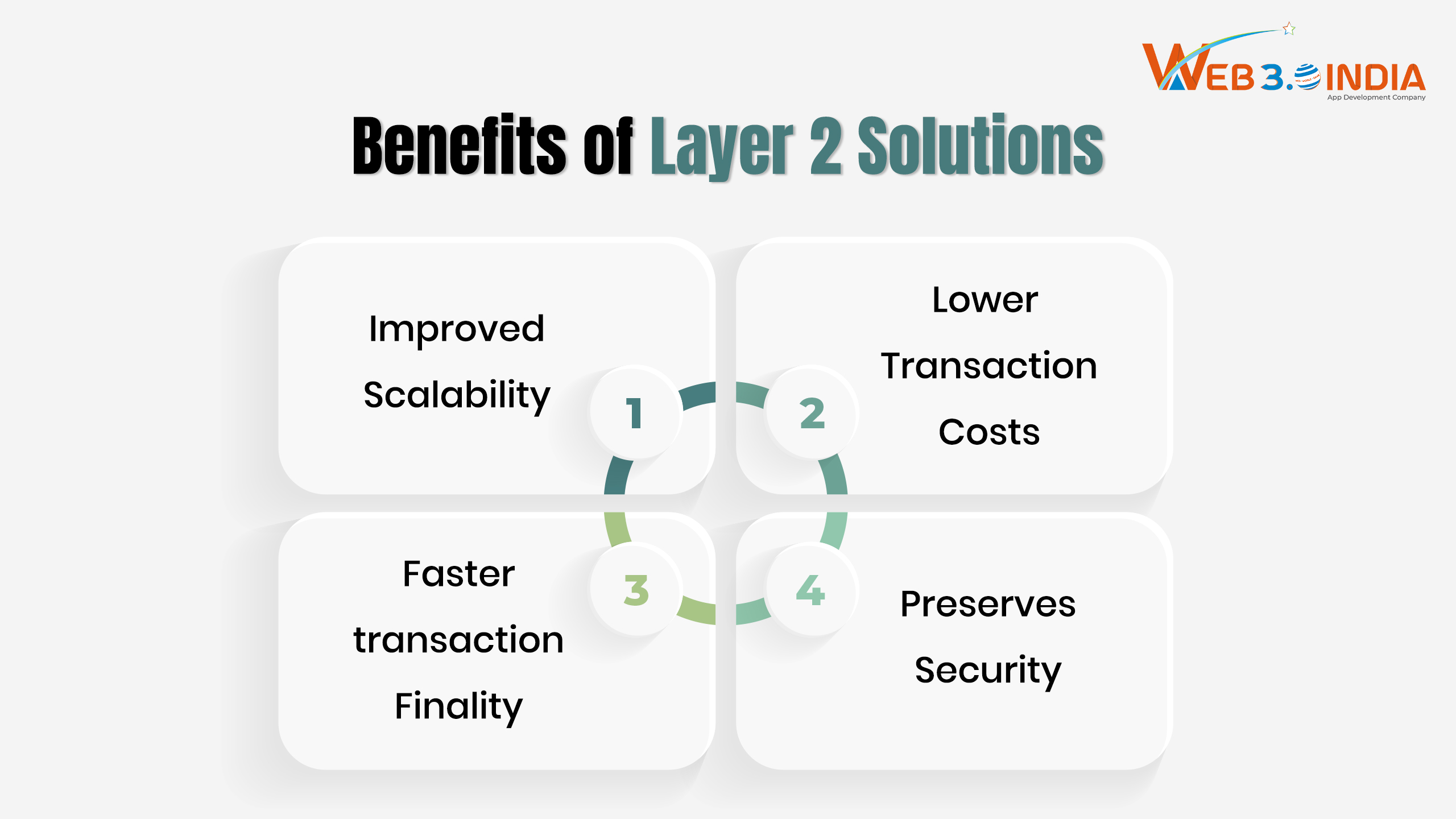
Improved scalability
Ethereum has a throughput rate of 10 to 15 TPS. This limits the network’s ability to deal with high network activity. As a result, transactions take a lot of time to get validated and executed. However, with Layer 2 networks, the throughput can be scaled significantly. Both Arbitrum and Polygon can execute thousands of transactions per second without congesting the network. Also, these secondary networks reduce pressure on the parent network by offloading execution. The Layer 1 chain is responsible only for validation and consensus.
Lower transaction costs
Another benefit of investing in Layer 2 solutions is lowered transaction costs. All the transactions are bundled up into batches and then offloaded to the secondary network. Thanks to the higher execution rate, the transaction fee charged on the Layer 2 network is significantly lower. Even during peak network activities, the gas fees don’t surge much. Apart from this, using the Layer 2 network optimizes the transaction validation process. As a result, computational costs can be further reduced by several notches.
Faster transaction finality
All the transactions can be processed in near real-time using Layer 2 blockchain networks. Validations are done on the primary parent network. This greatly enhances Ethereum’s scalability and allows faster transaction finality. Besides, a richer user experience can be delivered through dApps that require instant transaction verification.
Preserves security
Both Polygon and Arbitrum inherit Ethereum’s built-in, native security protocols. Additionally, all the transactions are validated on Ethereum’s network only. As a result, the chances of fraudulent activities and invalid transactions can be lowered significantly. Apart from this, end-to-end irreversibility of the executed transactions is handled on the primary Layer 1 network. This makes the block spaces immutable.
Implications for developers and users
For developers
Developers can deploy dApps, smart contracts, and other protocols seamlessly on the Layer 2 blockchain network. They won’t have to build separate security layers or architecture for the secondary network. Rather, they use the built-in infrastructure to improve Ethereum’s scalability.
For users
Users can access their wallets through the Layer 2 blockchain network without any restriction. Transaction speed will be increased significantly even during peak activities. This prevents users from paying surged gas fees on Ethereum. Apart from this, faster transaction finality delivers a rich user experience. 
Conclusion
Here, we have discussed the benefits of investing in Layer 2 solutions for Ethereum. Increased transaction efficiency, lower gas fees, and better resource utilization are some of the key advantages. On top of this, with Polygon and Arbitrum, Ethereum can be scaled seamlessly for better performance delivery. At Web 3.0 India, we help businesses leverage Layer 2 solutions to maximize blockchain efficiency. Ready to scale your Ethereum projects? Get in Touch Today!