
10 Best Metaverse Crypto Projects To Watch Out For in 2023
Everyone has very little or no knowledge about the Metaverse. What does it mean and how does it work? We might not...

Build immersive applications that bring digital content into physical environments or create fully interactive virtual experiences.
Web 3.0 India develops custom AR, VR and mixed reality applications for training, product visualization, education, healthcare, retail, manufacturing, entertainment and enterprise use cases across mobile, desktop and XR devices.
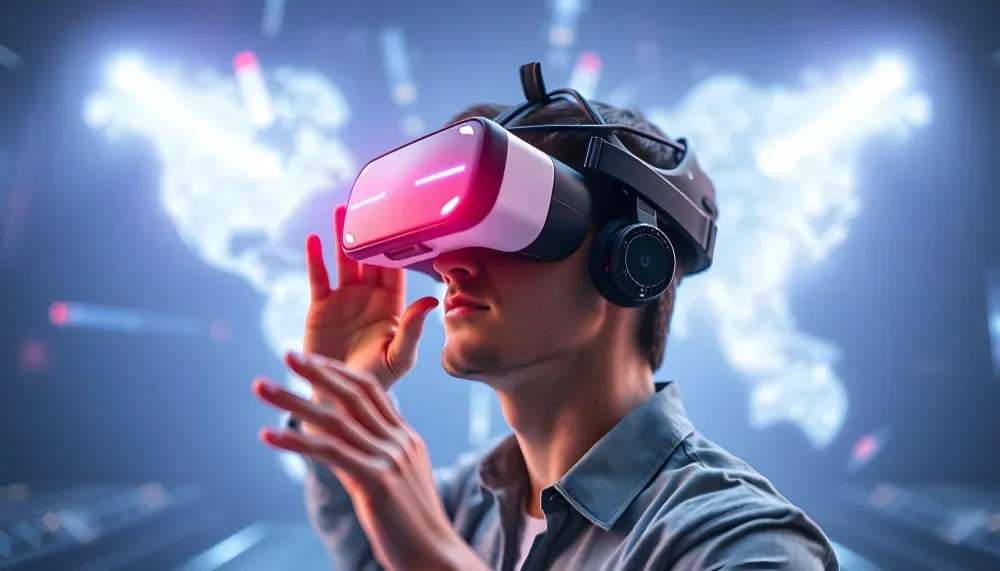




Successful AR/VR applications need more than 3D content. They need intuitive interaction, spatial understanding, device compatibility, real-time rendering, application logic and the infrastructure required to connect the experience with business systems.
Web 3.0 India combines 3D development, XR frameworks, computer vision, spatial interaction and software engineering to create AR/VR applications around specific business objectives.
From mobile AR experiences to immersive VR simulations, we design the technology around how users need to interact with the environment, content and application.
Create experiences that place digital content within real-world environments using supported mobile and wearable devices
Build fully immersive digital environments for training, simulation, education, gaming, visualization and enterprise applications.
Combine physical environments with interactive digital content, spatial understanding and real-world interaction.
Develop applications that use spatial positioning, environmental understanding and 3D interaction as part of the user experience.
Create interactive environments, objects, animations, scenes and visual experiences for AR and VR applications.
Implement interaction models using hand tracking, gestures, controllers and other supported input mechanisms.
Design experiences that respond to gaze and eye-based interaction where supported by the target device.
Connect immersive applications with APIs, cloud services, enterprise systems, IoT devices, AI services and other application infrastructure.
Create realistic environments for employee training, technical procedures, safety exercises and skills development.
Let customers and teams explore products, components and configurations through interactive 3D experiences
Build immersive environments for equipment visualization, maintenance training, factory planning and operational simulation.
Develop applications for medical education, visualization, simulation, patient experiences and healthcare training.
Create virtual product demonstrations, interactive shopping experiences, product visualization and immersive brand experiences.
Enable users to explore buildings, spaces and properties before physical construction or visits.
Build immersive classrooms, laboratories, simulations and interactive learning environments
Develop immersive experiences for entertainment, events, attractions and interactive digital content.
The user-facing AR, VR or mixed reality application across supported devices.
Environmental understanding, spatial mapping, anchors, positioning and real-world relationships.
Controllers, hand tracking, gestures, gaze, touch, voice and other supported interaction mechanisms.
Scenes, models, materials, lighting, animation, physics and real-time rendering.
Business logic, user flows, content management, interaction rules and application functionality.
APIs, cloud services, AI systems, IoT devices, enterprise applications and external platforms.
AR/VR applications become useful when interaction feels natural and purposeful.

Position digital objects relative to physical environments or defined virtual locations.

Enable users to interact with digital content through supported hand and gesture tracking.

Support physical controllers for navigation, object manipulation and application interaction.

Use gaze-based interaction for supported devices and experiences.

Allow users to select, move, inspect, configure and interact with virtual or augmented objects.

Integrate voice commands and conversational interfaces where they improve the experience.
Use supported haptic systems to provide physical feedback during virtual interactions.

Design movement, orientation and navigation models appropriate to the target device and application.
AR/VR development needs to account for the capabilities, interaction models and performance constraints of each target platform.
Build AR applications for supported iOS and Android devices using platform capabilities and frameworks such as ARKit and ARCore.
Develop immersive VR and mixed reality experiences for supported Quest devices.
Create high-fidelity VR experiences for compatible desktop and headset configurations.
Develop spatial experiences for supported Apple platforms and devices.
Build experiences for the evolving Android XR ecosystem and supported devices.
Use OpenXR where appropriate to target compatible AR, VR and MR runtimes through a common API approach. OpenXR 1.1 is the current published specification and continues to evolve through its extension ecosystem.
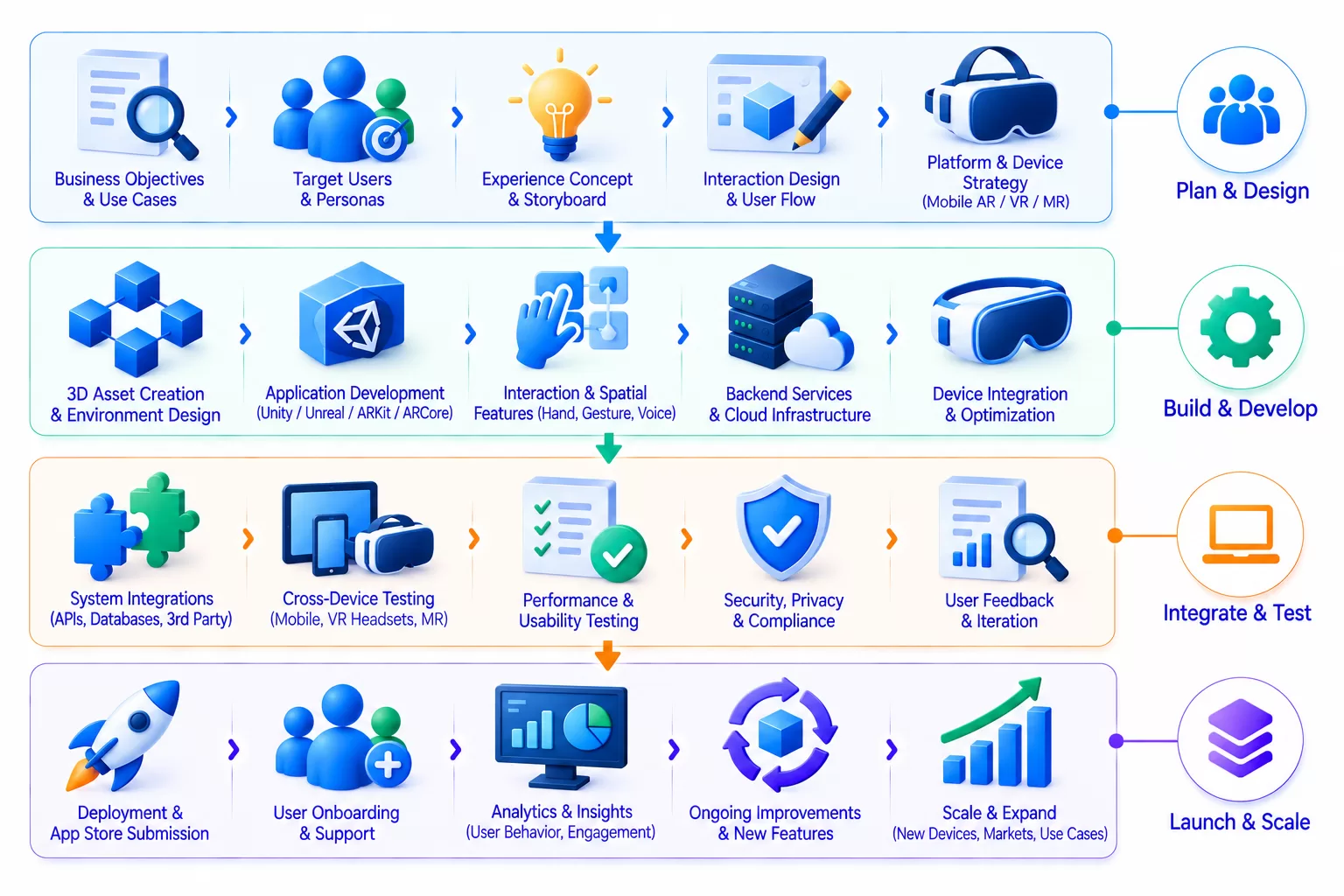
Understand the business objective, users, environment, target devices and expected interaction model.
Evaluate target hardware, capabilities, performance requirements and cross-platform considerations.
Define the application architecture, 3D pipeline, interaction model, integrations and infrastructure.
Build environments, assets, interactions, application functionality and device-specific experiences.
Connect required services and test interaction, tracking, performance, device compatibility and application behavior.
Validate application security, backend services, performance, stability and target-device behavior.
Prepare applications for the selected platforms and establish required backend and operational infrastructure.
Monitor application performance, user experience and platform behavior while improving the product through subsequent releases.
Identify the device, available capabilities and relevant physical or virtual environment.
Establish positioning, surfaces, anchors, tracking and spatial relationships where required.
Load and render the appropriate 3D environment, objects and digital content.
Process controller, touch, hand, gaze, voice or other supported user input.
Apply business logic, update objects, trigger interactions and respond to the user's actions.
Exchange information with APIs, cloud services, AI systems, enterprise applications or connected devices.
Integrate AI models, object recognition, computer vision, voice interfaces and intelligent assistants
Connect AR/VR applications with ERP, CRM, LMS, HR, product and other business systems.
Connect sensors, equipment and physical devices with immersive applications.
Integrate cloud APIs, databases, storage, authentication and application services.
Connect asset repositories, content management systems and 3D production workflows.
Capture application usage, interaction and experience data for performance and product analysis.
Immersive applications can process identity information, device data, spatial information, user interactions and connected business data. Security needs to be considered across the complete application architecture.
Secure user accounts, authentication, sessions and access to application functionality.
Manage application permissions and access to device capabilities such as cameras, microphones, sensors and tracking systems.
Apply appropriate controls around environmental, positional and spatial information collected by the application.
Protect application logic, APIs, backend services and third-party integrations.
Secure proprietary 3D models, environments, digital content and application assets
Monitor application activity, backend events, errors, access and security-relevant actions
Tokens can support ownership, access, incentives, payments and participation across a growing range of blockchain applications.
Training, equipment visualization, factory planning and maintenance assistance
Medical education, simulation, visualization and immersive healthcare experiences
Virtual product experiences, visualization, immersive commerce and brand engagement
Virtual property tours, architectural visualization and spatial planning.
Interactive learning environments, virtual laboratories and immersive training
Vehicle visualization, product configuration, virtual showrooms and training.
Virtual destinations, property experiences and immersive customer engagement
Interactive experiences, immersive content, events and digital entertainment.
Employee training, collaboration, onboarding, visualization and operational applications.
A well-designed token can become a functional component of the product or ecosystem rather than simply another digital asset.

Help customers and teams interact with products and environments rather than relying only on static content.

Create realistic simulations where users can practice processes and procedures in controlled environments.

Allow teams to explore products, facilities and concepts before physical implementation.

Create memorable product demonstrations, retail experiences and interactive brand engagements.

Enable teams to work together inside shared digital environments where appropriate

Build 3D assets, environments and application components that can support multiple use cases and platforms.
Showcase verified Web 3.0 India projects related to AR/VR, immersive applications, 3D visualization, training simulations, interactive experiences or XR.
Explore insights on AR/VR development, immersive applications, mixed reality, spatial computing, XR platforms, 3D development, computer vision, virtual training and interactive digital experiences.
Everyone has very little or no knowledge about the Metaverse. What does it mean and how does it work? We might not...
Today, smart contracts are beneficial for companies. This in-depth guide goes into great detail about their unique...
Everyone must be aware of how important it is to have a website in order to make a mark in the IT business industry...
Welcome to the next gaming frontier, where virtual worlds collide with reality to create immersive experiences like...
DeFi is an innovative system that will fundamentally change global finance. In summary, DeFi is an open monetary sy...
Everyone has very little or no knowledge about the Metaverse. What does it mean and how does it work? We might not...
Today, smart contracts are beneficial for companies. This in-depth guide goes into great detail about their unique...
Everyone must be aware of how important it is to have a website in order to make a mark in the IT business industry...
Welcome to the next gaming frontier, where virtual worlds collide with reality to create immersive experiences like...
DeFi is an innovative system that will fundamentally change global finance. In summary, DeFi is an open monetary sy...
Where connections are brewed, ideas percolate, and inspiration flows!
Let’s hear about your project. Drop us the details or send us a direct email
 24/7 Support