
10 Best Metaverse Crypto Projects To Watch Out For in 2023
Everyone has very little or no knowledge about the Metaverse. What does it mean and how does it work? We might not...

Build games that combine compelling gameplay, polished visuals and reliable technology across mobile, PC, console and immersive platforms.
Web 3.0 India develops custom games from concept and game mechanics to 2D and 3D production, multiplayer infrastructure, backend systems, monetization, testing and live operations.














A successful game is more than its graphics. Gameplay systems, controls, progression, performance, networking, player accounts, content delivery and backend services all need to work together.
Web 3.0 India approaches game development as a complete product engineering process. We combine game design implementation, 2D and 3D development, real-time systems, multiplayer infrastructure, backend engineering and platform optimization.
Whether the project is a mobile game, multiplayer title, PC or console game, simulation or immersive experience, the technology is designed around the intended player experience.
Build engaging 2D games with custom mechanics, characters, environments, animations, UI and progression systems
Create interactive 3D worlds with characters, physics, environments, lighting, animation and gameplay systems.
Develop games optimized for Android and iOS with touch controls, mobile performance and platform-specific requirements.
Build high-performance games for desktop and supported console platforms with platform-specific optimization.
Develop real-time or session-based multiplayer experiences with player synchronization, matchmaking, sessions and networking.
Build backend services for player accounts, profiles, progression, inventories, leaderboards, game data and live operations.
Create interfaces for menus, inventories, maps, progression, social features, shops and in-game interactions.
Optimize rendering, memory, loading, network traffic and device performance for the target hardware.
Develop accessible mobile and web games built around simple mechanics, short sessions and repeat engagement.
Build gameplay systems around resource management, planning, progression, competitive play and strategic decision-making.
Develop character-driven gameplay with combat, exploration, missions, environments and progression.
Build player progression, character systems, quests, inventories, abilities, combat and world exploration.
Create interactive simulations around physical systems, environments, vehicles, processes or specialized scenarios.
Develop competitive or cooperative experiences with matchmaking, player sessions, real-time synchronization and social features.
Build gameplay systems for racing, sports mechanics, player control, scoring, competition and progression.
Create interactive games designed around learning, training, awareness or professional skill development.
Game screens, menus, HUDs, interfaces, animations and player-facing experiences.
Game rules, mechanics, player actions, progression, missions, abilities and interaction systems.
Scenes, environments, physics, lighting, AI behaviors, objects and simulation systems.
Networking, player synchronization, sessions, matchmaking, lobbies and real-time communication.
Player profiles, inventories, progression, leaderboards, game state and application APIs.
Player data, game configuration, analytics, content and operational databases.
Implement movement, combat, interaction, missions, objectives, scoring and other core game mechanics.
Develop player characters, NPCs, abilities, animation states, progression and behavior systems.
Implement collisions, movement, environmental interaction and physics-based gameplay.
Create navigation, decision-making, enemy behavior, companion systems and other game AI mechanics.
Build levels, experience, achievements, unlocks, rewards and player progression.
Develop inventories, items, currencies, rewards, crafting and other game economy systems.
Enable friends, teams, chat, profiles, leaderboards, communities and player interaction where required.
Support events, seasonal content, configuration changes and new gameplay content without requiring a complete application rebuild.
Multiplayer introduces a separate engineering layer involving networking, synchronization, player sessions, backend services and operational monitoring.
Manage registration, authentication, profiles, progression and player data.
Connect players based on game mode, availability, region or other defined criteria.
Create rooms and game sessions for cooperative, competitive or private gameplay.
Synchronize player actions, game state and relevant events between connected players.
Track scores, rankings, achievements and competitive performance.
Integrate supported voice, messaging and communication systems for multiplayer experiences.
Capture gameplay events, player behavior, performance and engagement data.
Support monitoring, configuration, content updates, events, issue management and ongoing game operations.
Secure accounts, authentication flows, sessions and access to player information.
Keep important gameplay and progression logic protected from client-side manipulation wherever architecture allows.
Apply server-side validation, anti-cheat controls and network protections appropriate to the game.
Protect virtual currencies, purchases, rewards, inventories and other economic systems.
Secure game APIs, databases, cloud services and administrative interfaces.
Protect proprietary game assets, downloadable content and other controlled game resources.
Apply appropriate permissions around game administration, configuration and live operations.
Monitor unusual activity, errors, gameplay events, transactions and security-relevant actions.

Integrate social login, platform accounts, authentication providers and player identity services.

Connect matchmaking, lobbies, networking, player services and game backend infrastructure.

Integrate platform payments, in-game purchases, subscriptions and other supported monetization systems.

Connect analytics platforms to understand player behavior, engagement, retention and game performance.

Integrate databases, APIs, storage, content delivery and cloud infrastructure.

Connect chat, friends, communities, notifications and supported social functionality.

Integrate AI for NPC behavior, procedural content, player personalization, moderation or game-support experiences where appropriate.
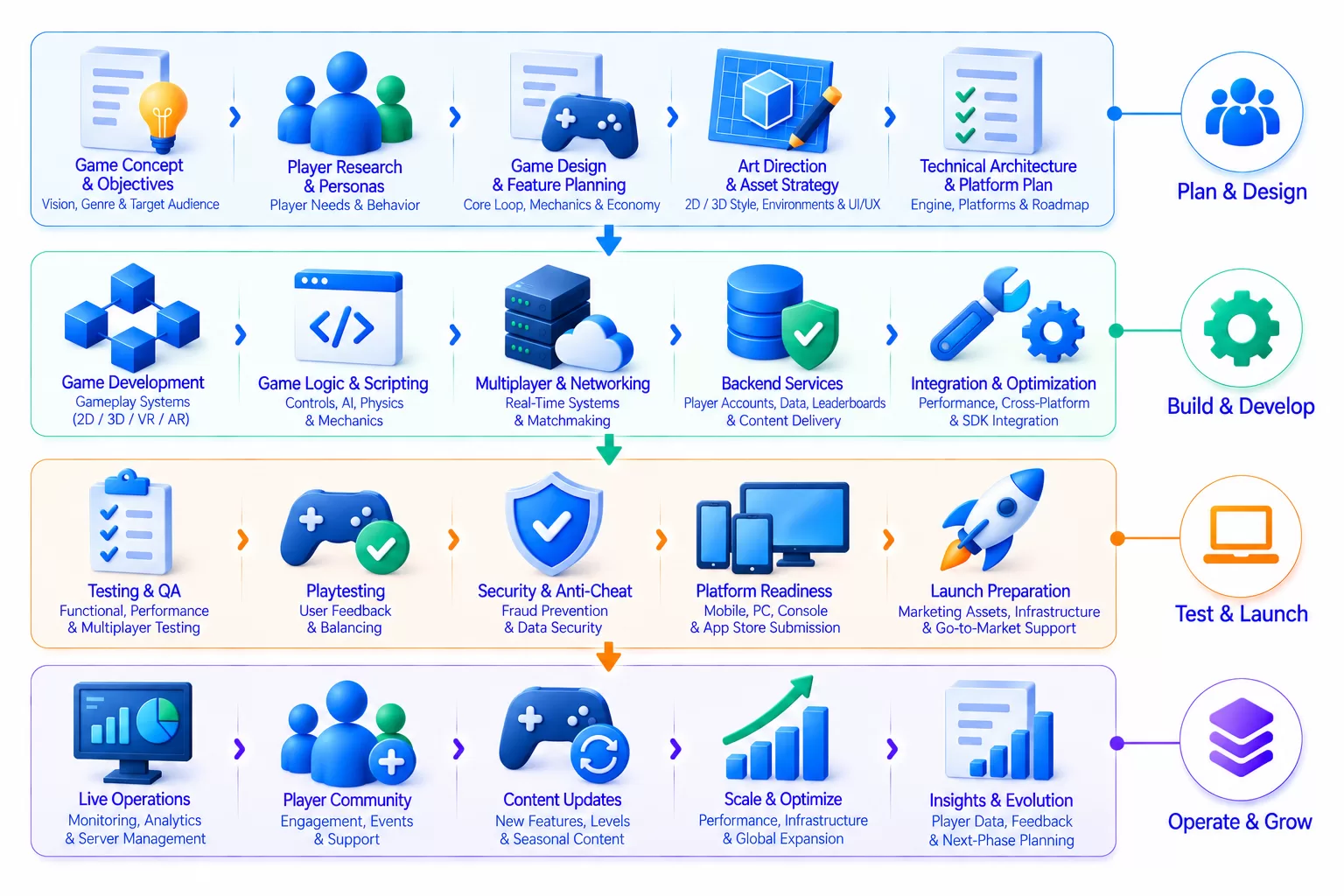
Understand the game concept, target audience, gameplay loop, platforms, scope and technical requirements.
Define game mechanics, architecture, technology stack, art requirements, multiplayer model and production roadmap.
Build the core gameplay experience to validate mechanics, technical feasibility and the intended player experience.
Develop gameplay systems, environments, characters, UI, animations, audio integration and backend functionality.
Implement networking, player services, platform functionality, payments, analytics and other required integrations.
Test gameplay, compatibility, performance, network behavior, security, controls and user experience across target platforms.
Prepare builds, backend infrastructure, platform submissions and production environments for release.
Monitor the game after launch, analyze player behavior, address issues and continuously improve content and performance.
Tokens can support ownership, access, incentives, payments and participation across a growing range of blockchain applications.
Build original titles, co-development projects and new game products.
Turn game concepts and prototypes into commercially deployable products
Develop educational games, simulations and interactive learning experiences.
Use game mechanics and simulations for workforce training, onboarding and skill development.
Create interactive entertainment products connected to broader media and audience ecosystems.
Build sports games, fan engagement experiences and interactive competitions.
Develop branded games and interactive experiences for customer engagement.
Loyalty, rewards and digital ownership through blockchain tokens.
Create game-based social environments, interactive worlds and multiplayer experiences.

Build responsive gameplay, intuitive controls and polished interactions around the target audience.

Design the architecture around the platforms that matter to the game and its audience.
Create networking and backend infrastructure that can evolve with player and feature requirements.

Use gameplay analytics to understand player behavior and guide future improvements.

Support live content, events, balancing and configuration changes after launch.

Build systems that allow new gameplay, features and integrations to be added without rebuilding the entire product.
Showcase verified Web 3.0 India projects relevant to game development, interactive applications, multiplayer platforms, simulations or immersive experiences.
Explore insights on game development, multiplayer architecture, Unity, Unreal Engine, game backend development, mobile gaming, game optimization, game AI, immersive gaming and live game operations.
Everyone has very little or no knowledge about the Metaverse. What does it mean and how does it work? We might not...
Today, smart contracts are beneficial for companies. This in-depth guide goes into great detail about their unique...
Everyone must be aware of how important it is to have a website in order to make a mark in the IT business industry...
Welcome to the next gaming frontier, where virtual worlds collide with reality to create immersive experiences like...
DeFi is an innovative system that will fundamentally change global finance. In summary, DeFi is an open monetary sy...
Everyone has very little or no knowledge about the Metaverse. What does it mean and how does it work? We might not...
Today, smart contracts are beneficial for companies. This in-depth guide goes into great detail about their unique...
Everyone must be aware of how important it is to have a website in order to make a mark in the IT business industry...
Welcome to the next gaming frontier, where virtual worlds collide with reality to create immersive experiences like...
DeFi is an innovative system that will fundamentally change global finance. In summary, DeFi is an open monetary sy...
Where connections are brewed, ideas percolate, and inspiration flows!
Let’s hear about your project. Drop us the details or send us a direct email
 24/7 Support