
10 Best Metaverse Crypto Projects To Watch Out For in 2023
Everyone has very little or no knowledge about the Metaverse. What does it mean and how does it work? We might not...

Build decentralized applications, financial products, payment systems, digital assets and consumer platforms on Solana's high-performance blockchain infrastructure.
Web30 India develops Solana applications using Rust and Anchor programs, Solana's account-based architecture, token infrastructure, wallets, onchain programs and integrations required to take products from development to production.
Solana approaches application execution differently from EVM-based blockchains. Programs are stateless executable accounts, while mutable application state is stored in separate accounts. Instructions specify the programs and accounts involved, and multiple instructions can be combined into an atomic transaction.
This architecture creates a different development model for applications, particularly around account design, program interactions, transaction construction and state management.
Web30 India works with these native Solana concepts to build financial applications, marketplaces, payment platforms, tokenized assets, gaming products, consumer applications and other onchain systems.
Solana's Token Extensions Program, commonly associated with Token-2022, adds optional functionality directly to token mints and token accounts. This allows asset behavior to be designed into the token architecture rather than implementing every requirement through separate application contracts.
Configure rules around how tokens can be transferred.
Implement token-level transfer fee mechanisms where required.
Support operational controls for pausing token transfers.
Support privacy-oriented transfer functionality where applicable.
Configure a mint-level delegate authority with capabilities defined by the token's architecture.
Associate token metadata directly with the token infrastructure.
These capabilities can be relevant to stablecoins, regulated assets, loyalty systems, enterprise assets and other applications with specific operational requirements.
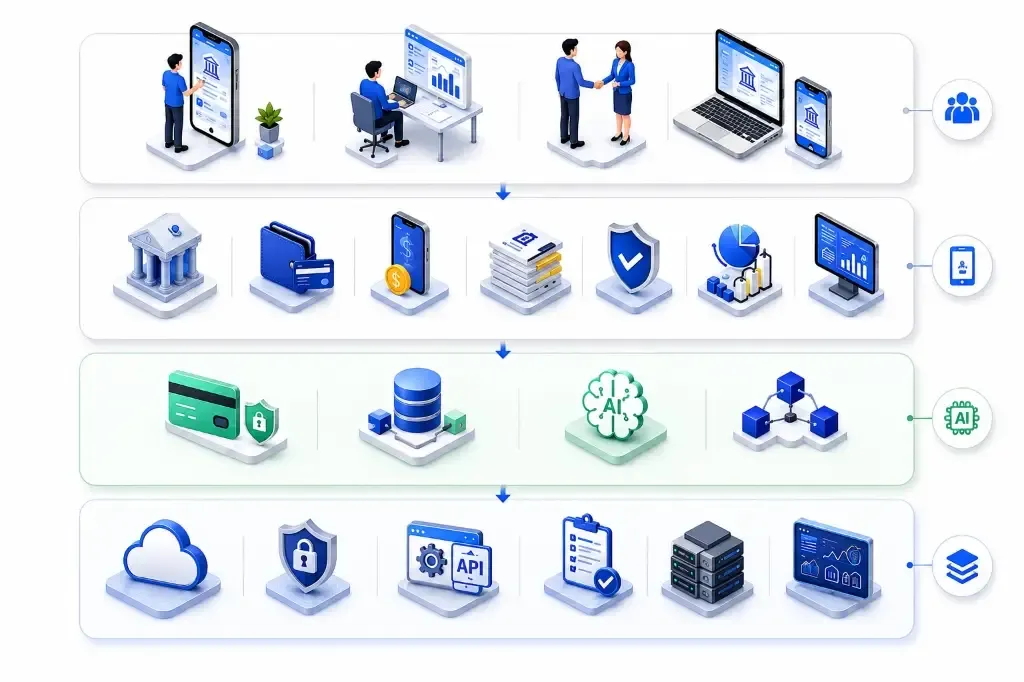
Solana uses a distinct execution architecture built around accounts, programs, instructions and transactions. Its ecosystem also includes Token Extensions, payment infrastructure, DeFi protocols, digital assets, developer frameworks and application tooling.







Build custom onchain programs using Rust, Anchor or lower-level Solana development approaches.
Develop complete decentralized applications connecting Solana programs with web, mobile and backend infrastructure.
Build swaps, liquidity platforms, staking applications, lending products and other programmable financial systems.
Create fungible and non-fungible assets using Solana's token programs and Token Extensions.
Implement token functionality using Token Extensions for capabilities such as transfer controls, transfer fees, metadata, pausability and other token-level behavior.
Build NFT collections, marketplaces, digital ownership systems, creator platforms and application-specific digital assets.
Build payment and settlement applications using Solana-based assets, stablecoins, wallets and transaction infrastructure.
Develop tokenized asset infrastructure covering issuance, asset controls, settlement, ownership and onchain operations.
Develop decentralized exchanges, liquidity applications, staking platforms, lending systems and other financial protocols.
Build merchant payments, stablecoin transfers, payouts, settlement and treasury applications around Solana infrastructure.
Create infrastructure for stablecoins, securities, funds, loyalty assets and other tokenized real-world assets.
Build marketplaces for collectibles, creator assets, gaming items, memberships and digital experiences.
Develop blockchain-enabled gaming experiences with digital assets, player ownership, rewards and onchain game mechanics.
Build applications where wallets, digital assets and blockchain transactions are integrated into familiar consumer experiences.
Build trading, settlement, asset management and other financial workflows using Solana's onchain execution environment.
Develop business applications around payments, tokenized assets, digital records, loyalty and programmable transactions.
Solana's architecture is centered around accounts and programs rather than the contract-and-storage model commonly used in EVM networks. Programs contain executable logic, while application state is held in accounts passed into program instructions.
Accounts are the primary storage model on Solana. They hold data and are owned by programs that define how that data can be modified.
Solana programs contain executable sBPF bytecode and are designed to be stateless. Application state is maintained separately in data accounts.
Instructions define an operation against a specific program and identify the accounts required for execution.
Multiple instructions can be composed into a transaction and executed atomically, allowing several program interactions to form one application workflow.
PDAs provide deterministic addresses derived from program-defined seeds and are commonly used to organize program-controlled accounts and application state.
CPIs allow one Solana program to invoke another program, enabling composable application architecture and interactions between onchain components.
Solana programs are primarily developed in Rust. Anchor provides a higher-level framework for building Solana programs, while native Rust development provides more direct control over program behavior and optimization.
Validate instruction inputs, account ownership, signer requirements, authorities and program state transitions.
Design account relationships carefully and validate every account passed into program instructions.
Protect transaction construction, signing, instruction parameters and user authorization.
Secure wallet connections, signing flows, key management and transaction permissions.
Protect APIs, authentication, frontend applications, backend services and offchain infrastructure.
Monitor program interactions, transaction activity, authority changes, application events and infrastructure health.
Solana's program model places particular importance on account validation and program-controlled state because programs receive the accounts they operate on through instructions.
Build stablecoin payment, merchant settlement, treasury and global payout applications.
Develop exchanges, liquidity platforms, lending, staking and other onchain financial products.
Issue and manage tokenized securities, stablecoins, loyalty assets and other real-world assets.
Build marketplaces, creator platforms, collectibles, memberships and application-specific digital assets.
Use Solana programs and digital assets for player-owned items, rewards, marketplaces and onchain game mechanics.
Build applications where blockchain transactions and digital assets are integrated into everyday product experiences.
Use Solana for payment, asset, settlement and programmable transaction workflows.
Build the underlying token, wallet, marketplace and transaction infrastructure required by Web3 products.
A user initiates an operation through a web, mobile or other application interface.
The application creates one or more instructions containing the target program, required accounts and instruction data.
The transaction is presented to the user's wallet or signing infrastructure for authorization.
The signed transaction is submitted to Solana infrastructure through an RPC endpoint.
Solana executes the referenced instructions against the supplied accounts and programs.
Successful instructions update the relevant accounts and produce transaction results that can be consumed by the application.
Integrate browser, mobile, embedded and custodial wallets into Solana applications.
Connect stablecoins, merchant payment systems, payout platforms and settlement infrastructure.
Integrate token issuance, Token Extensions, NFT systems and asset management platforms.
Connect RPC providers, indexing services, explorers, event pipelines and application databases.
Integrate KYC, KYB, identity verification, access control and transaction monitoring systems where required.
Connect Solana applications with ERP, CRM, financial systems, databases and other business infrastructure.

Understand the product, users, assets, transactions, offchain systems and blockchain requirements.
Define the program structure, account model, transaction flows, authorities, PDAs and application boundaries.
Design Rust or Anchor programs, account structures, token architecture and cross-program interactions.
Build the frontend, backend, wallet experience, programs, APIs and supporting infrastructure.
Test program logic, account validation, transaction flows, integrations and failure scenarios across development and test environments.
Connect wallets, RPC infrastructure, token systems, payment platforms and other required services before production deployment.
Monitor transactions, program performance, application infrastructure and operational activity.
Extend the application with additional assets, programs, integrations, payment flows and product capabilities as it grows.




Explore practical insights on Solana development, Rust programs, Anchor, account architecture, Token Extensions, Solana payments, DeFi, NFTs, gaming, tokenization and Web3 application development.
Everyone has very little or no knowledge about the Metaverse. What does it mean and how does it work? We might not...
Today, smart contracts are beneficial for companies. This in-depth guide goes into great detail about their unique...
Everyone must be aware of how important it is to have a website in order to make a mark in the IT business industry...
Welcome to the next gaming frontier, where virtual worlds collide with reality to create immersive experiences like...
DeFi is an innovative system that will fundamentally change global finance. In summary, DeFi is an open monetary sy...
Everyone has very little or no knowledge about the Metaverse. What does it mean and how does it work? We might not...
Today, smart contracts are beneficial for companies. This in-depth guide goes into great detail about their unique...
Everyone must be aware of how important it is to have a website in order to make a mark in the IT business industry...
Welcome to the next gaming frontier, where virtual worlds collide with reality to create immersive experiences like...
DeFi is an innovative system that will fundamentally change global finance. In summary, DeFi is an open monetary sy...
Everything you need to know about our enterprise blockchain engineering process, costs, security, and architectures.
Where connections are brewed, ideas percolate, and inspiration flows!
Let’s hear about your project. Drop us the details or send us a direct email
 24/7 Support