
Is Your Business Losing Opportunities by Staying Fully Centralized?
As digital transformation accelerates, businesses are under constant pressure to deliver greater transparency, stronger security, and more engaging user experiences. However, many organizations still rely entirely on traditional applications built around centralized infrastructure.
While centralized systems have powered the internet for decades, they also introduce limitations that can hinder innovation and scalability in today's Web3-driven economy.
Common challenges include:
- Centralized control over data and operations
- Single points of failure that increase downtime risks
- Limited transparency for users and stakeholders
- Growing cybersecurity threats targeting centralized databases
- Dependence on intermediaries that add operational costs
These challenges are becoming increasingly relevant as users demand greater control over their data, digital assets, and online interactions.
At the same time, a new opportunity is emerging.
Businesses across industries are exploring decentralized technologies to create more transparent, resilient, and user-centric platforms. The rise of blockchain infrastructure has enabled organizations to build applications that operate without relying on a central authority.
This shift has fueled the growth of:
- Decentralized applications (dApps)
- Web3 ecosystems
- Blockchain-powered automation
- Trustless business models
For startups, enterprises, and Web3 entrepreneurs, the key question is no longer whether blockchain technology matters; it's whether their current application architecture is prepared for the next generation of digital experiences.
The solution begins with understanding the differences between a dApp and a traditional app.
Choosing the right architecture can significantly impact:
- Security
- Scalability
- User trust
- Operational efficiency
- Long-term business growth
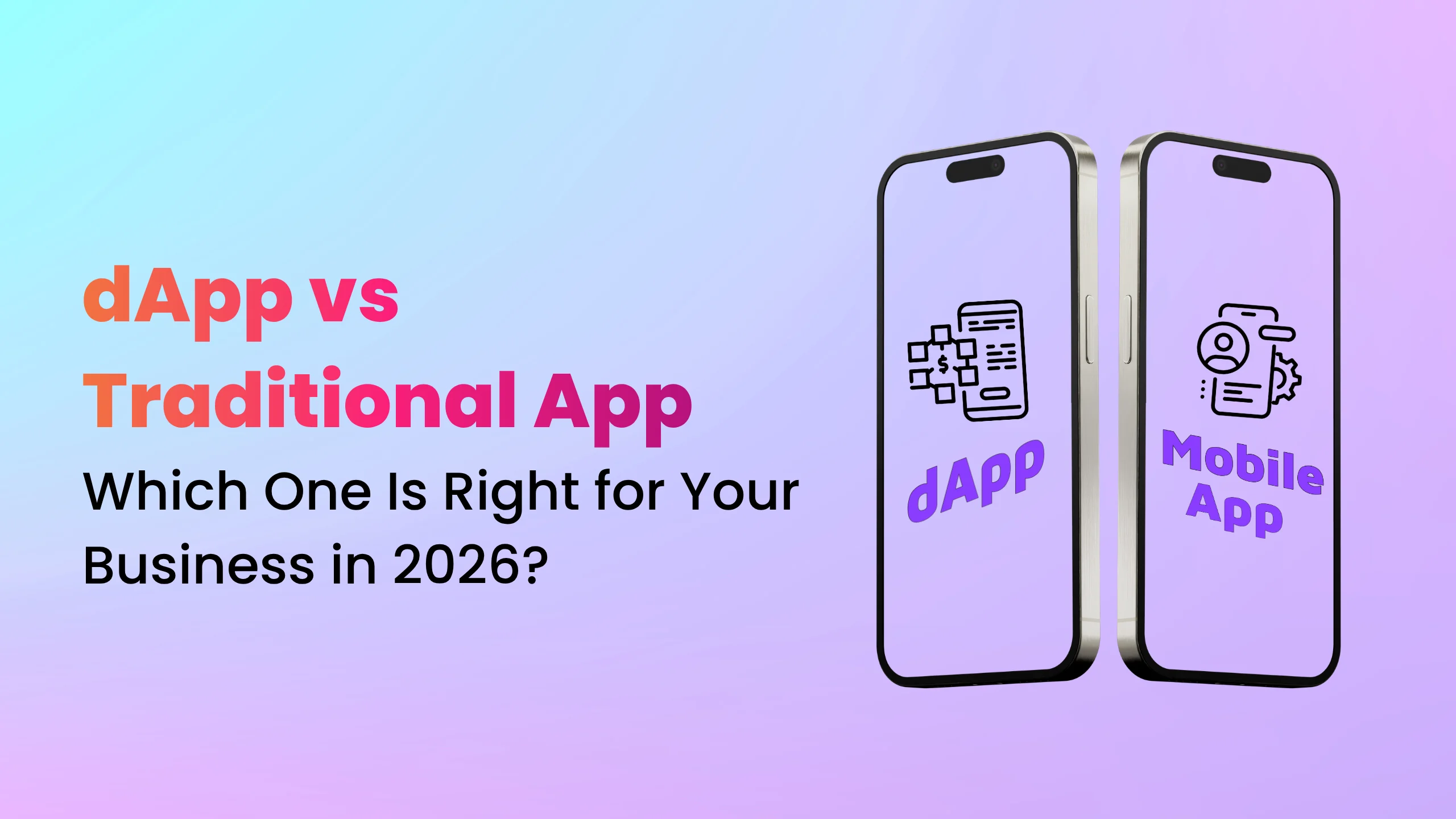
What is a dApp vs Traditional App?
Traditional Application
A traditional application is software that operates through centralized servers controlled by a company or service provider.
Examples include:
- Banking applications
- E-commerce platforms
- CRM systems
- SaaS solutions
- Social media platforms
dApp
A decentralized application (dApp) is software that operates on blockchain infrastructure rather than centralized servers.
Examples include:
- DeFi protocols
- NFT marketplaces
- DAO governance platforms
- Blockchain gaming ecosystems
dApp vs Traditional App: Quick Comparison
| Feature | Traditional App | dApp |
| Data Storage | Centralized | Decentralized |
| Ownership | Company-Controlled | Community/User-Controlled |
| Security | Server-Based | Blockchain-Based |
| Transparency | Limited | High |
| Downtime Risk | Higher | Lower |
| Authentication | Email & Password | Wallet-Based |
| Governance | Centralized | Decentralized |
Business Benefits of Choosing dApp Development Services
As Web3 adoption continues to expand, businesses are increasingly investing in dApp Development Services to create secure, transparent, and future-ready digital platforms.
Unlike traditional applications, dApps offer unique advantages that can transform business operations, customer engagement, and revenue generation.
Enhanced Transparency & Trust
Transparency is one of the most significant benefits of decentralized applications.
Because transactions and activities are recorded on blockchain networks:
- Users can independently verify actions
- Data integrity becomes easier to maintain
- Organizations build stronger trust with stakeholders
This is particularly valuable in industries where transparency directly impacts user confidence.
Improved Security Through Blockchain
Traditional applications often store critical information in centralized databases, making them attractive targets for cyberattacks.
dApps improve security through:
- Distributed blockchain architecture
- Cryptographic protection
- Immutable transaction records
- Smart contract automation
These features significantly reduce the risk of unauthorized data manipulation.
Reduced Dependence on Intermediaries
Many traditional business processes require third-party intermediaries to verify, approve, or process transactions.
dApps eliminate much of this dependency through smart contracts that automatically execute predefined rules.
Benefits include:
- Faster operations
- Lower transaction costs
- Increased efficiency
- Reduced administrative overhead
Greater User Ownership & Control
One of the defining advantages of decentralized applications is user empowerment.
dApps allow users to:
- Control their digital assets
- Manage their identities through wallets
- Participate in governance systems
This creates stronger engagement and aligns with modern Web3 expectations.
New Revenue Opportunities Through Tokenization
Many dApps integrate tokenized ecosystems that create additional revenue models.
Examples include:
- Utility tokens
- Governance tokens
- NFT-based economies
- Staking mechanisms
- Community incentives
These models enable businesses to generate value beyond traditional subscription or transaction-based approaches.
Technical Differences Between dApp vs Traditional App
Backend Architecture
The backend is where the most fundamental difference exists between a dApp and a traditional application.
Traditional App
Traditional applications rely on centralized servers managed by an organization or cloud provider.
Typical components include:
- Application servers
- Centralized databases
- API gateways
- Cloud infrastructure
The organization maintains complete control over system operations, updates, and data management.
dApps
Decentralized applications operate on blockchain networks and smart contracts.
Instead of centralized servers:
- Business logic runs through smart contracts
- Transactions are validated by blockchain nodes
- Data is distributed across a decentralized infrastructure
This eliminates reliance on a single authority and creates a more resilient ecosystem.
Database Management
Data management plays a critical role in application performance and trust.
Traditional App
Traditional apps use centralized databases such as:
- MySQL
- PostgreSQL
- MongoDB
- Microsoft SQL Server
The application owner controls:
- Data storage
- Access permissions
- Database updates
Although efficient, centralized databases can become vulnerable to data breaches and unauthorized modifications.
dApps
dApps rely on blockchain ledgers and decentralized storage systems.
Common solutions include:
- Ethereum blockchain
- IPFS (InterPlanetary File System)
- Arweave
- Filecoin
Because blockchain records are immutable, data integrity becomes significantly stronger.
Benefits include:
- Tamper resistance
- Improved auditability
- Greater transparency
Authentication Models
Authentication directly affects user ownership and privacy.
Traditional App
Users typically access applications through:
- Email and password combinations
- Social logins
- Multi-factor authentication
User identities are stored and managed by the organization.
dApps
Most decentralized applications use wallet-based authentication.
Examples include:
- MetaMask
- Trust Wallet
- WalletConnect-supported wallets
Users authenticate through cryptographic signatures rather than sharing personal credentials.
Advantages include:
- Enhanced privacy
- Self-sovereign identity
- Reduced credential management risks
Smart Contract Integration
One of the most powerful differences in the dApp vs. traditional app comparison is smart contract functionality.
Traditional applications often require intermediaries or administrators to verify and execute actions.
dApps automate these processes using smart contracts.
Examples include:
- Automated payments
- Governance voting
- Asset transfers
- Escrow services
- Token issuance
Smart contracts execute predefined rules automatically once conditions are met.
Benefits include:
- Reduced operational overhead
- Faster execution
- Increased trust
- Improved transparency
When Should Your Business Choose a dApp?
Not every business requires decentralization. However, organizations that prioritize transparency, user ownership, automation, and trust can gain significant advantages from decentralized application development.
Below are some of the most common scenarios where dApp Development Services provide measurable value.
Financial Services & DeFi Platforms
Decentralized Finance is one of the strongest use cases for dApps.
Applications include:
- Decentralized exchanges
- Lending protocols
- Yield farming platforms
- Asset tokenization systems
Benefits:
- Trustless transactions
- Transparent financial operations
- Reduced intermediary costs
NFT & Digital Asset Marketplaces
NFT ecosystems require verifiable ownership and transparent transactions.
dApps enable:
- NFT minting
- Marketplace trading
- Royalty automation
- Digital asset management
Blockchain infrastructure ensures authenticity and ownership verification.
DAO Governance Systems
Organizations implementing decentralized governance often require dApp infrastructure.
DAO-focused applications support:
- Proposal management
- Voting mechanisms
- Treasury governance
- Community participation
These systems create transparent and community-driven decision-making environments.
Supply Chain Transparency Platforms
Supply chains often involve multiple stakeholders and data verification challenges.
dApps help organizations:
- Track assets
- Verify transactions
- Improve transparency
- Reduce fraud
This is particularly valuable in manufacturing, logistics, and retail industries.
Gaming & Metaverse Applications
Gaming and metaverse ecosystems increasingly depend on decentralized infrastructure.
dApps enable:
- Digital asset ownership
- Play-to-earn economies
- NFT integration
- Decentralized marketplaces
This creates stronger engagement and new monetization opportunities.
Why Choose Web 3.0 India for dApp Development Services?
Building a successful decentralized application requires more than blockchain expertise. It demands a partner that understands business objectives, user behavior, security requirements, and scalable Web3 architecture.
Web 3.0 India helps startups, enterprises, and innovators transform ideas into secure, scalable, and future-ready decentralized applications.
End-to-End Web3 Application Development
From concept validation to deployment and maintenance, our team manages the complete development lifecycle.
Our dApp Development Services include:
- Business consulting
- Blockchain architecture design
- Smart contract development
- Wallet integration
- Security auditing
- Post-launch support
This end-to-end approach ensures consistency, scalability, and faster time-to-market.
Proven Blockchain & Smart Contract Expertise
Our blockchain specialists have experience developing:
- DeFi platforms
- NFT marketplaces
- DAO governance systems
- Asset tokenization platforms
- Enterprise blockchain applications
We prioritize:
- Security-first development
- Smart contract reliability
- Scalable architecture
- Performance optimization
Organizations worldwide choose Web 3.0 India for our commitment to quality, innovation, and long-term partnerships.