
Why Blockchain Solutions Are a Strategic Priority in 2026
In 2026, blockchain is no longer an experimental technology. It has become a strategic infrastructure layer for businesses that need transparency, automation, and trust in their digital operations. However, many organizations still struggle with scalability, data integrity, and centralized control, which limits innovation and increases operational risk.
Traditional systems were not designed for decentralized economies. They rely heavily on intermediaries, manual verification, and siloed data structures. This makes them slow, expensive to maintain, and vulnerable to manipulation or data breaches. As global business ecosystems become more interconnected, these limitations are no longer sustainable.
This is where blockchain development solutions become a strategic necessity rather than a technical upgrade.
Blockchain provides a foundation for:
- Trustless and transparent transactions
- Automated execution through smart contracts
- Immutable data storage
- Decentralized system architecture
At the same time, enterprise adoption of blockchain is accelerating. Industries such as finance, supply chain, healthcare, and digital assets are actively investing in blockchain development services to modernize their core systems.
The opportunity lies in using custom blockchain development to build solutions that are:
- Scalable
- Secure
- Business-driven
- Future-ready
The solution is not just adopting blockchain, but adopting it strategically through well-designed blockchain development solutions that align technology with long-term business objectives.
What Are Blockchain Development Solutions?
Blockchain development solutions refer to the design, development, and deployment of decentralized systems using blockchain technology. These solutions include building blockchain networks, smart contracts, decentralized applications (DApps), and Web3 platforms that operate without centralized control.
In practical terms, blockchain development solutions cover:
- Smart contract development
- Decentralized application development
- Enterprise blockchain solutions
- Web3 development solutions
- Custom blockchain platforms
They enable businesses to create systems that are transparent, tamper-proof, and automated by design.
What are blockchain development solutions?
Blockchain Development Solutions refer to building decentralized platforms, smart contracts, and Web3 applications using blockchain technology to create secure, transparent, and automated digital ecosystems.
Business Value of Blockchain Solutions
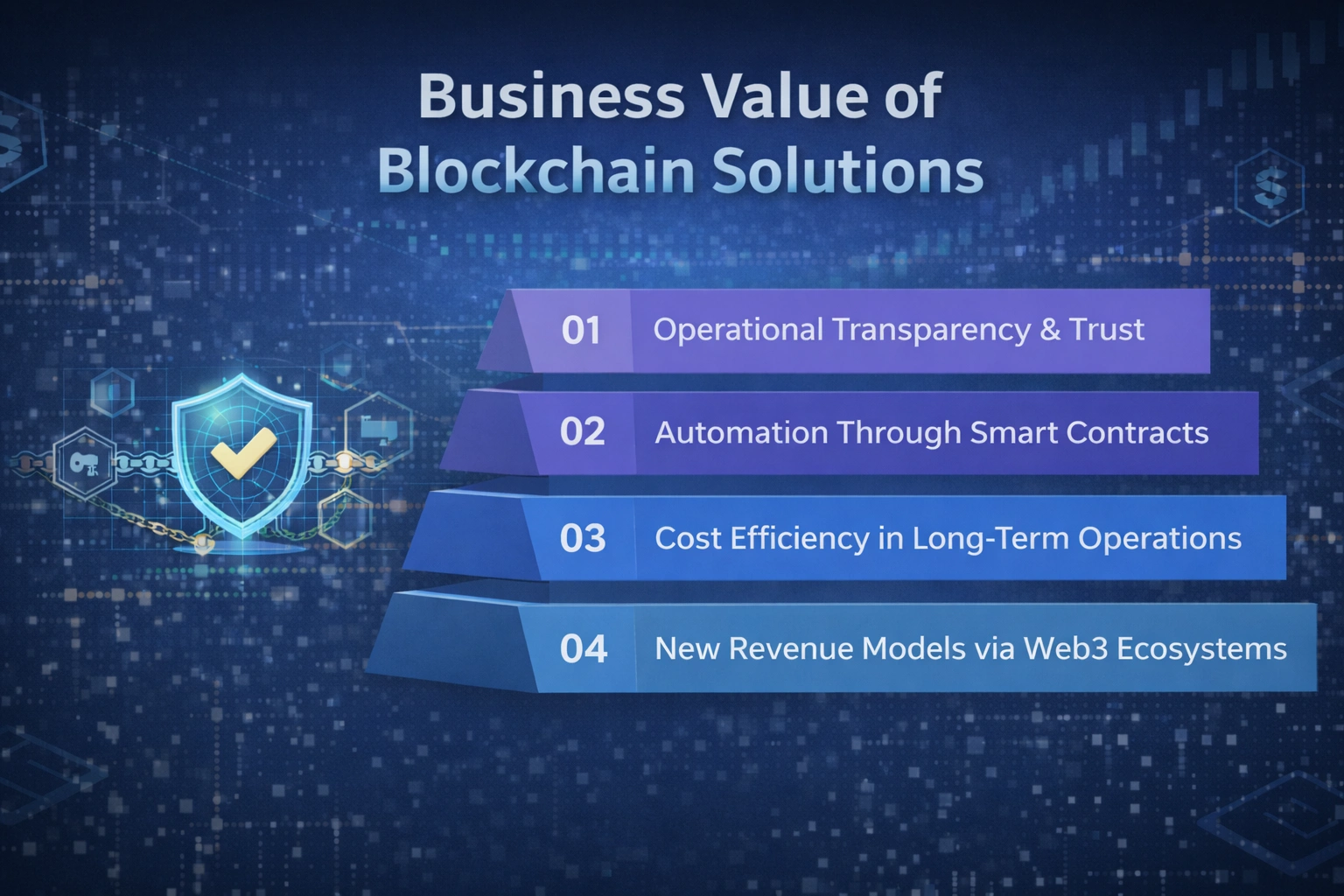
Blockchain development solutions deliver measurable business value by improving transparency, reducing operational costs, and enabling new digital revenue models. When implemented strategically, they transform blockchain from a technology experiment into a long-term competitive advantage.
Operational Transparency & Trust
Blockchain creates a single source of truth. Every transaction is recorded on an immutable ledger that can be verified by all stakeholders.
This enables:
- Complete auditability
- Elimination of data manipulation
- Stronger regulatory compliance
- Increased customer and partner trust
For enterprises, transparency becomes a business differentiator rather than a compliance burden.
Automation Through Smart Contracts
Smart contract development allows businesses to automate processes such as:
- Payments
- Asset transfers
- Compliance enforcement
- Agreement execution
This reduces:
- Manual intervention
- Human error
- Processing time
Automation increases operational efficiency while lowering administrative costs.
Cost Efficiency in Long-Term Operations
Although blockchain projects require upfront investment, they significantly reduce long-term operational expenses by:
- Removing intermediaries
- Minimizing reconciliation costs
- Automating governance
Over time, blockchain implementation becomes more cost-effective than traditional centralized systems.
New Revenue Models via Web3 Ecosystems
Blockchain enables new monetization opportunities through:
- Tokenized assets
- Decentralized marketplaces
- NFT platforms
- Web3 membership ecosystems
This allows companies to move beyond traditional business models and participate in decentralized digital economies.
Technical Foundation of Blockchain Development Solutions
The success of blockchain development solutions depends on a strong technical foundation that ensures security, scalability, performance, and long-term sustainability. This foundation combines blockchain architecture, smart contract engineering, and decentralized data infrastructure into a unified ecosystem.
Blockchain Architecture & Consensus Models
Blockchain architecture defines how data is stored, validated, and shared across the network. The choice of architecture depends on business requirements such as speed, privacy, and decentralization.
Common architectures include:
- Public blockchains: Fully decentralized and transparent (e.g., Ethereum, Solana)
- Private blockchains: Controlled access for enterprises
- Consortium blockchains: Shared control among trusted organizations
Consensus models ensure agreement across the network. Popular mechanisms include:
- Proof of Stake (PoS)
- Delegated Proof of Stake (DPoS)
- Practical Byzantine Fault Tolerance (PBFT)
The right combination of architecture and consensus model directly impacts transaction speed, security, and scalability.
Smart Contract Design Principles
Smart contracts are the core execution layer of Blockchain Development Solutions. They automate business logic and enforce rules without intermediaries.
Strong smart contract design focuses on:
- Security-first coding practices
- Modular and upgradeable architecture
- Gas optimization
- Extensive testing and auditing
Smart contract development ensures:
- Automated transactions
- Transparent governance
- Reliable enforcement of agreements
This is where business rules become executable code.
Decentralized Storage & APIs
Blockchain is not ideal for storing large files. Decentralized storage systems complement blockchain by handling data efficiently.
Common approaches include:
- IPFS for distributed file storage
- Cloud + blockchain hybrid models
- Decentralized databases
APIs connect blockchain networks with:
- Frontend applications
- Enterprise systems
- External services
This integration enables seamless decentralized application development and real-world usability.
Industry Use Cases of Blockchain Development Solutions
Blockchain development solutions are being adopted across multiple industries to solve trust, security, and efficiency challenges that traditional systems cannot handle.
FinTech & Digital Payments
In finance, blockchain enables:
- Secure peer-to-peer payments
- Fraud-resistant transaction systems
- Transparent financial records
Enterprise blockchain solutions are transforming:
- Cross-border payments
- Digital banking platforms
- Tokenized financial instruments
Supply Chain & Logistics
Blockchain improves supply chain operations by:
- Tracking goods in real time
- Preventing data manipulation
- Enhancing traceability
It ensures authenticity, transparency, and accountability across global logistics networks.
Healthcare Data Management
Healthcare organizations use blockchain to:
- Secure patient records
- Control data access
- Improve interoperability
Blockchain ensures data privacy while enabling seamless information sharing.
Gaming, NFTs & Metaverse
Web3 development solutions power:
- NFT marketplaces
- Play-to-earn gaming platforms
- Digital asset ownership
Blockchain provides provable ownership, scarcity, and monetization models.
Asset Tokenization & Real Estate
Blockchain enables:
- Fractional ownership
- Transparent asset trading
- Automated revenue distribution
Tokenized assets unlock new investment models and global market access.
Cost & Investment Insight for Blockchain Solutions
Understanding the blockchain project cost structure helps businesses plan budgets and evaluate ROI realistically.
Cost Factors in Blockchain Projects
The total cost depends on:
- Blockchain platform selection
- Smart contract complexity
- Security audit requirements
- DApp development scope
- Infrastructure setup
Projects that require advanced compliance or multi-chain deployment typically involve higher investment.
MVP vs Enterprise-Grade Development Costs
For startups:
- Focus on MVP development
- Limited feature set
- Faster deployment
- Lower initial cost
For enterprises:
- Full-scale blockchain architecture
- Compliance integration
- High security standards
- Long-term maintenance planning
Enterprise blockchain solutions require higher investment but offer greater scalability and reliability.
ROI Potential from Blockchain Adoption
Blockchain delivers ROI through:
- Reduced operational costs
- Improved transparency
- Automation of processes
- New revenue streams
When implemented strategically, Blockchain Development Solutions generate long-term financial and operational value.
Why Choose Web 3.0 India for Blockchain Development Solutions
Selecting the right development partner defines the success of your blockchain initiative. Web 3.0 India combines technical excellence with business-centric delivery to create scalable and reliable Blockchain Development Solutions.
With Web 3.0 India, you get:
- End-to-end blockchain development expertise
- Cost-effective and scalable delivery
- Global project execution experience
- Secure and enterprise-ready solutions
Let us help you turn your idea into a powerful blockchain ecosystem.