

10 Best Metaverse Crypto Projects To Watch Out For in 2023
Everyone has very little or no knowledge about the Metaverse. What does it mean and how does it work? We might not...

Develop permissioned blockchain networks designed around business identity, governance, privacy and multi-party collaboration. Web30 India works with Hyperledger technologies to build enterprise blockchain infrastructure, chaincode, applications, integrations and network architectures for organizations that need controlled participation and shared business records.

Hyperledger provides an ecosystem of enterprise-focused distributed ledger technologies. Our implementation approach selects the right framework and architecture based on the business model, participants, privacy requirements and application environment.







Enterprise blockchain projects require more than putting transactions on a shared ledger. They need clearly defined participants, identities, permissions, governance policies, business logic, application interfaces and operational controls.
Hyperledger Fabric provides a permissioned architecture where organizations and users operate through verifiable identities and policies. Its channel model can separate business activity between defined groups of participants, while chaincode contains the application logic that interacts with the ledger.
Design and develop permissioned blockchain networks using Fabric for multi-organization business environments, shared records and controlled transactions.
Build Ethereum-compatible enterprise blockchain environments using Hyperledger Besu for organizations that require private or permissioned networks with Ethereum tooling and interfaces.
Define peers, ordering services, channels, organizations, identities, policies and infrastructure according to the requirements of the network.
Develop business logic for asset management, transaction processing, approvals, ownership changes and other enterprise workflows.
Design identity and membership structures that determine which organizations, applications and users can participate and what actions they can perform.
Connect Hyperledger networks with existing applications through APIs, gateways, middleware and application services.
Design data-sharing models that allow organizations to control which participants can access specific business information.
Define policies, organizational responsibilities, transaction endorsement requirements and operational governance for consortium networks.
Connect manufacturers, suppliers, logistics providers and distributors through shared transaction and asset records.
Create shared infrastructure for trade documents, approvals, verification and multi-party workflows.
Build controlled blockchain environments for financial institutions and other participants that need shared transaction infrastructure.
Create permissioned environments for controlled data exchange, consent workflows, clinical records and multi-party coordination.
Represent and manage business assets through permissioned digital records and programmable transaction workflows.
Build identity-driven blockchain applications where participants need verifiable organizational or user credentials.
Create tamper-evident records for documents, certificates, approvals and other business information.
Connect organizations through shared business processes where multiple parties need a common source of transaction history.
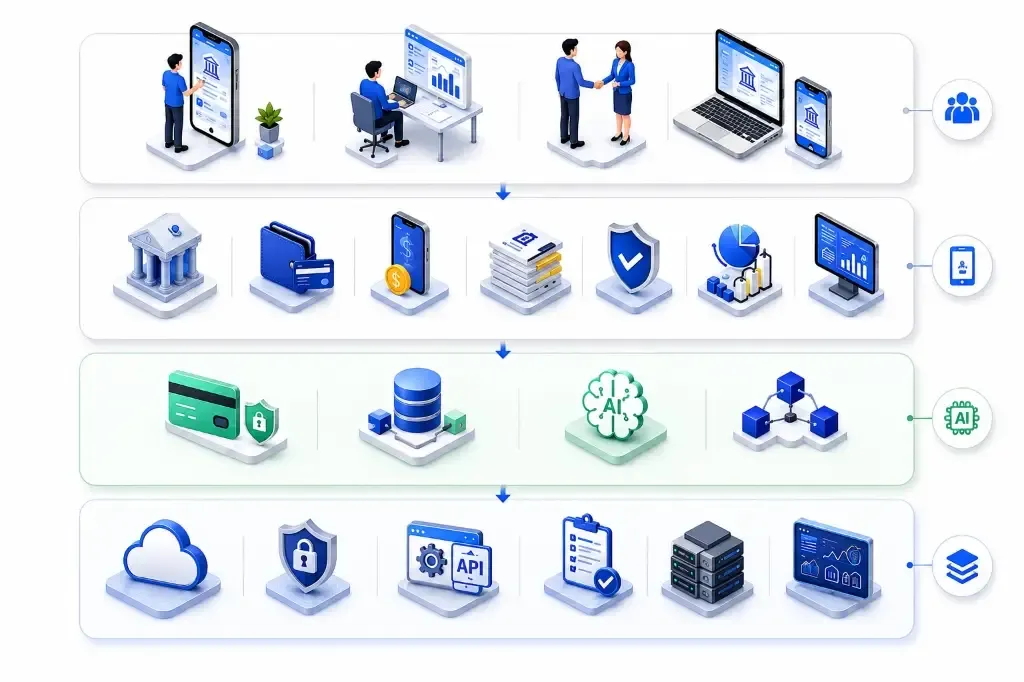
Hyperledger implementations are structured around the relationships between organizations, identities, applications, business logic and ledger infrastructure. In Fabric, organizations can participate in channels with defined policies, while chaincode governs business transactions and endorsement requirements.
Web applications, mobile applications, enterprise portals and business interfaces.
APIs, middleware, event services, gateways and connectors linking blockchain with existing systems.
Chaincode and business rules that define how transactions modify shared business records.
Peers, ordering services, channels and organizational network components.
Certificate authorities, membership services, organizational identities, policies and permissions.
Distributed ledgers, world state databases and controlled data structures.
Cloud, containers, Kubernetes, networking, storage, monitoring and operational infrastructure.

Define the businesses, institutions or entities participating in the network.

Maintain ledger copies and execute or endorse transaction proposals according to network rules.

Provides transaction ordering and block distribution within the network.

Create separate communication and ledger environments for defined groups of organizations.

Contains the business logic used to create and process transactions.

Establishes trusted organizational identities and determines participation and permissions.

Issues digital certificates used to establish verifiable identities within the network.

Define which organizations must approve a transaction before it can be committed.
Connect blockchain workflows with enterprise resource planning and operational applications.
Integrate participant, customer and business relationship data with blockchain processes.
Synchronize blockchain applications with existing relational and enterprise databases where appropriate.
Build integration layers between blockchain networks and external applications.
Connect organizational identity and authentication infrastructure with Hyperledger network permissions.
Deploy and operate Hyperledger environments across suitable cloud and infrastructure platforms.
Connect ledger and application data with reporting, monitoring and analytics systems.
Use blockchain infrastructure alongside connected devices where trusted transaction or asset records are required.
Track products, movements, ownership changes and business events across participating organizations.
Coordinate documentation, approvals and transaction events between financial institutions and trading partners.
Create controlled infrastructure for sharing selected information between authorized healthcare participants.
Manage verifiable identities and permissions across organizational networks.
Maintain shared records for ownership, transfers, lifecycle events and asset-related workflows.
Create verifiable records for certificates, approvals, contracts and other business documents.
Coordinate transaction and settlement workflows between organizations using shared business rules.
Build permissioned infrastructure for records, verification and multi-agency workflows.

Understand participants, workflows, data requirements, governance and the business problem being addressed.
Evaluate Fabric, Besu or other suitable technologies against privacy, interoperability, performance and operational requirements.
Define organizations, peers, channels, identities, policies, infrastructure and application architecture.
Translate business rules into chaincode and transaction workflows.
Build user-facing applications and connect the network with enterprise systems, APIs and databases.
Test transaction flows, permissions, network behavior, integrations and failure scenarios.
Deploy the network infrastructure, applications and operational components into the target environment.
Monitor network health, application behavior and operational performance while improving the implementation over time.








Explore practical perspectives on enterprise blockchain, Hyperledger development, distributed systems, digital assets, blockchain architecture and emerging technology.
Everyone has very little or no knowledge about the Metaverse. What does it mean and how does it work? We might not...
Today, smart contracts are beneficial for companies. This in-depth guide goes into great detail about their unique...
Everyone must be aware of how important it is to have a website in order to make a mark in the IT business industry...
Welcome to the next gaming frontier, where virtual worlds collide with reality to create immersive experiences like...
DeFi is an innovative system that will fundamentally change global finance. In summary, DeFi is an open monetary sy...
Everyone has very little or no knowledge about the Metaverse. What does it mean and how does it work? We might not...
Today, smart contracts are beneficial for companies. This in-depth guide goes into great detail about their unique...
Everyone must be aware of how important it is to have a website in order to make a mark in the IT business industry...
Welcome to the next gaming frontier, where virtual worlds collide with reality to create immersive experiences like...
DeFi is an innovative system that will fundamentally change global finance. In summary, DeFi is an open monetary sy...
Everything you need to know about our enterprise blockchain engineering process, costs, security, and architectures.
Showcase verified Web30 India projects relevant to Hyperledger, enterprise blockchain, healthcare, supply chain, financial infrastructure or other permissioned blockchain applications. Use actual project screenshots, architecture visuals and measurable outcomes where available. Do not add fictional case studies, client names or performance figures.
Where connections are brewed, ideas percolate, and inspiration flows!
Let’s hear about your project. Drop us the details or send us a direct email
 24/7 Support